THE SHORT ANSWER
What matters most.
Start with the business outcome. Use conversion-focused bidding when the primary actions you track represent useful outcomes; use value-based bidding only when the conversion values meaningfully distinguish those outcomes. Compare Maximize Conversions with Target CPA, and Maximize Conversion Value with Target ROAS. Confirm measurement first, read average targets rather than expecting every result to match, and test one meaningful change at a time.
QUICK REFERENCE
Key takeaways.
- KEY POINT 01Smart Bidding optimizes for conversions or conversion value at auction time; it is not the same as every automated bid strategy.
- KEY POINT 02Choose between conversion count and conversion value before choosing a strategy name.
- KEY POINT 03Maximize Conversions and Target CPA are built around conversion counts; the latter uses an average CPA goal.
- KEY POINT 04Maximize Conversion Value and Target ROAS are for value-based goals and depend on useful conversion values.
- KEY POINT 05A target is an average goal for bidding—not a guaranteed cost or return on every lead, sale or auction.
- KEY POINT 06Check primary conversion actions, lead quality and value measurement before expanding automation.
- KEY POINT 07Google began changing Search strategy labels in June 2026; older and newer names may appear during rollout.
THE BASICS / AUTOMATION WITH A DEFINED GOAL
Understand what Smart Bidding does
Google defines Smart Bidding as automated bid strategies that use Google AI to optimize for conversions or conversion value in each auction. The auction-time system considers signals such as device, location, time of day and language when setting bids. This can help account for differences between individual searches, but it does not know whether a business considers a particular enquiry a good fit unless the account’s measurement communicates that outcome.
Smart Bidding is a subset of automated bidding, not a synonym for every automated option in Google Ads. Strategies that optimize for clicks or impression share have different objectives. Before comparing a setting, confirm the campaign type, the conversion goal and the exact result the business wants the bidding strategy to pursue.
For a Mumbai campaign, location signals do not replace choosing the areas a business can serve. Review geographic targeting, service availability, landing-page details and follow-up capacity separately. A bid strategy can optimize only within the campaign setup and signals it receives.
| Question | Why it matters |
|---|---|
| What should the campaign optimize for? | A useful conversion count or reliable conversion value—not a convenient but low-quality event. |
| Is this a Smart Bidding strategy? | Confirm it optimizes for conversions or conversion value at auction time. |
| What does automation not decide? | Whether an enquiry is qualified, a sale is profitable or the service area is correct. |
CAMPAIGN GOAL / COUNT OR VALUE
Decide whether conversion count or value matters
A lead-generation campaign may first need more enquiries that meet a clear qualification standard. An ecommerce business may care more about the revenue or margin represented by each order. Those are different optimization questions. Write down the outcome before choosing the bid strategy, then check that the account records it in a way Google Ads can use.
If every counted conversion is treated as equally valuable, a count-focused strategy may fit the measurement model. If conversions have genuinely different business values and those differences are sent accurately, a value-focused strategy may be more appropriate. Assigning arbitrary high values to form submissions simply to use value bidding can teach the campaign the wrong lesson.
A click, page view or button tap may help diagnose the path, but it is not automatically a qualified lead or sale. Decide which action should guide bidding and which actions should remain observations. Google advises advertisers to confirm conversion tracking and set the conversion actions they want to optimize for as Primary.
| Business question | Measurement to verify | Strategy family to compare |
|---|---|---|
| How many meaningful actions can we generate? | One consistent, correctly counted primary conversion | Maximize Conversions or Target CPA |
| Which outcomes contribute more business value? | Reliable values that distinguish conversion importance | Maximize Conversion Value or Target ROAS |
| Are we only measuring traffic? | Clicks and visits do not establish lead or sale quality | Fix the goal before using conversion-focused bidding |
FOUR OPTIONS / DIFFERENT CONTROL QUESTIONS
Compare the four main Smart Bidding choices
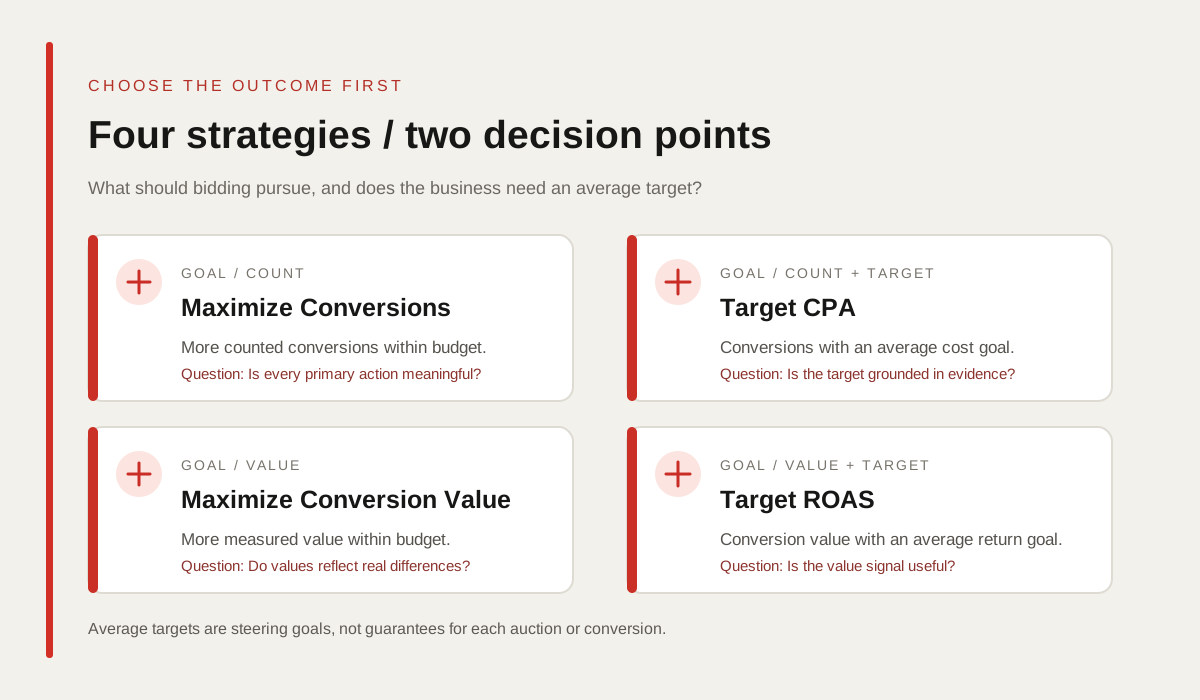
The first choice is what to maximize: the number of conversions or their measured value. The second is whether to use a target. Maximize strategies pursue more of the selected outcome within the budget settings; Target CPA and Target ROAS add a target to the corresponding outcome.
These are not four levels from “basic” to “advanced.” The right comparison is whether the conversion data is trustworthy, whether outcomes have useful differences in value, and whether the business has a reason to set a target based on its own economics. Use the goal that matches the decision the business needs to make.
| Strategy | Optimizes toward | Useful question before choosing |
|---|---|---|
| Maximize Conversions | More conversions within the campaign budget | Is each primary conversion a meaningful action? |
| Target CPA | Conversions with an average cost-per-action goal | Is the target grounded in actual lead or sale economics? |
| Maximize Conversion Value | More total measured conversion value within budget | Do the values accurately distinguish business outcomes? |
| Target ROAS | Conversion value with an average return-on-ad-spend goal | Does the value signal and target reflect profitable outcomes? |
MEASUREMENT / TEACH THE RIGHT SIGNAL
Verify the conversion actions before changing bids
Open the conversion goals used by the campaign and list the actions marked Primary. Confirm that each action records once when the intended event happens, that it belongs to the correct account goal and that it is not simply a proxy chosen because it is easy to trigger. Test the full journey from the ad’s landing page through the confirmation or completion state.
For enquiries, review what happens after submission. If the business can distinguish qualified enquiries from spam, duplicates or out-of-area requests, use that feedback to assess campaign quality. Where a suitable sales or CRM process exists, connect downstream outcomes to measurement rather than treating every form as equally valuable. Protect customer information and follow the platform’s and business’s privacy requirements.
Do not change a bidding goal to compensate for broken tracking. First fix duplicate tags, missing events, incorrect values, or a thank-you page that can be revisited and counted again. Then compare the platform’s reported actions with the business’s own records.
- Confirm the conversion action that the campaign is optimizing for.
- Test that it fires at the intended moment and is counted correctly.
- Separate diagnostic events from the outcomes bidding should prioritize.
- Compare reported leads with qualified enquiries or completed sales where available.
COUNT-BASED BIDDING / MAXIMIZE OR SET A CPA GOAL
Choose Maximize Conversions or Target CPA
Maximize Conversions is designed to get as many conversions as possible within the budget. It can be a candidate when the primary conversion is reliable and the campaign’s main question is how many meaningful actions the available budget can generate. It is not a promise to spend a fixed amount every day or to produce a specific number of enquiries.
Target CPA adds an average cost-per-conversion goal. Google describes CPA as the desired average cost, and performance should be compared with the strategy’s average target CPA over the period being evaluated. Individual conversions can cost more or less; the target is not a hard per-lead ceiling. Base it on the economics of qualified outcomes, not on the cheapest form submission.
For a service business, calculate what an acquired customer can reasonably be worth and how often an enquiry becomes a customer before setting a target. If that evidence is missing, improve qualification and measurement first rather than entering an ambitious number and expecting automation to make it achievable.
| Use Maximize Conversions when… | Consider Target CPA when… |
|---|---|
| The priority is more tracked conversions within the set budget. | There is a credible average acquisition-cost goal to work toward. |
| The primary action is reliable and represents business value. | The team can evaluate average target CPA alongside qualified outcomes. |
| The team is not using a separate CPA target. | The target will not make the campaign uneconomical or too restrictive. |
VALUE-BASED BIDDING / OPTIMIZE FOR DIFFERENCES
Use value-based strategies only when value is meaningful
Maximize Conversion Value is intended to get the most measured conversion value from the campaign budget. Target ROAS adds an average return-on-ad-spend goal to that value-based objective. These strategies need more than a revenue-looking number: the values should be accurate, consistently recorded and connected to outcomes the business actually wants.
For ecommerce, a purchase value might reflect the transaction amount, though businesses may need margin context when revenue alone is not a good proxy for value. For lead generation, a value model should distinguish outcomes using defensible business evidence, such as later stages in a real sales process. If every enquiry is assigned the same invented value, value bidding cannot tell the difference between them.
Google reports average target ROAS as the traffic-weighted target used over a period, which may differ from the target set in the interface. Compare achieved value and cost with the average target and the business’s own margin or pipeline data; do not assume that each click or individual order will meet the target.
- Use conversion values that reflect real differences in importance.
- Check currency, value changes, duplicate purchases and refunds where relevant.
- Do not assign arbitrary values to low-intent events to inflate reported value.
- Compare average target ROAS with actual business economics over an appropriate period.
TARGETS / USE ACCOUNT EVIDENCE
Set targets from evidence, not aspiration alone
A target should be connected to what the business can afford and what the campaign has actually delivered for relevant outcomes. Review a comparable period, account for conversion delays and inspect the average target metric—not only the number currently entered in a setting. A recent target edit or a change in traffic mix can make the average target over the selected date range different from the latest setting.
An unrealistically strict CPA or ROAS target can constrain the campaign’s ability to participate in suitable auctions. A loose target can also produce a result that does not meet the business’s economics. Use a small, documented adjustment when evidence supports it, and assess both the platform metric and the quality of customers or leads.
No target guarantees a specific cost, return, ranking or sales volume. Competition, demand, budget, conversion tracking, landing-page experience and follow-up all affect what happens. Treat targets as steering settings that should be reviewed against actual business results.
| Before entering a target | Evidence to gather |
|---|---|
| Target CPA | Cost of qualified customers, lead-to-sale rate and the conversion delay. |
| Target ROAS | Reliable conversion values, margins or downstream revenue and the measurement window. |
| Either target | Comparable campaign periods and a record of recent changes that affect the average target. |
GOOGLE ADS INTERFACE / CHECK THE LABEL
Recognize the 2026 strategy-label changes
Google announced that it would begin changing how target-based Search bidding strategies are organized in June 2026. The interface is moving toward showing Target CPA and Target ROAS as standalone options instead of grouping them under Maximize Conversions or Maximize Conversion Value. During the rollout, different Google Ads surfaces may still show a mix of old and new wording.
Google says the label change does not itself change the bidding behavior. If an account shows “Maximize conversions with a Target CPA” while another surface shows “Target CPA,” compare the actual goal and setting rather than assuming the campaign switched objectives. The untargeted Maximize Conversions and Maximize Conversion Value names remain as separate options.
When documenting a campaign, record the visible label and the configured target. That helps teams understand older reports and screenshots without confusing a naming transition with a strategy change.
- Target CPA may appear as “Target CPA” or the older combined label during rollout.
- Target ROAS may appear as “Target ROAS” or the older combined label.
- Check the actual goal and target in the campaign, not just a saved screenshot.
- Google describes this as an interface-label change, not a new performance guarantee.
PRACTICAL WORKFLOW / CHANGE ONE THING AT A TIME
Run a measured Smart Bidding test
Start with one campaign and a clearly stated hypothesis. For example: “This service campaign should optimize for qualified consultation requests, so we will verify the primary enquiry action before testing Target CPA.” Set the business guardrails first: service locations, budget limits, landing page, qualified-lead definition and who follows up.
Record the current bidding strategy, target, conversion actions, budget, search themes and recent performance. Make the specific change, then review a period that accounts for normal conversion delay and enough activity to compare fairly. Avoid making several large edits at once; frequent changes make it harder to tell what caused a difference.
Evaluate spend, eligible traffic, reported conversions, qualified leads and sales outcomes together. If the platform reports more conversions but the team receives fewer relevant enquiries, inspect the conversion signal before increasing budget. Keep, refine or reverse the test based on evidence—not a promise that automated bidding will always outperform another approach.
- Write down the goal and one hypothesis before editing the campaign.
- Check the conversion action, geography, landing page, budget and follow-up path.
- Document the strategy label, target and date of each material change.
- Review qualified outcomes and spend alongside Google Ads reporting.
- Scale only when the measured result is useful and the business can handle the demand.
THE DETAILS
Questions worth
asking early.
Clear answers about google ads smart bidding in mumbai before you choose your next step.
Is Smart Bidding the same as every automated Google Ads strategy?
No. Google defines Smart Bidding around optimizing for conversions or conversion value at auction time. Other automated strategies may optimize for goals such as clicks or impression share instead.
Which Smart Bidding strategy should a Mumbai service business use?
It depends on what the campaign can measure reliably. Compare Maximize Conversions or Target CPA when the goal is meaningful conversion count; consider value-based bidding only when conversion values reflect real business differences.
Does Target CPA guarantee every enquiry will cost less than the target?
No. Target CPA is an average goal used by the strategy, not a per-enquiry price cap. Compare actual cost with the average target CPA and the quality and value of the leads.
Should every lead-generation campaign use Target ROAS?
No. Target ROAS requires useful conversion values. Use it only when those values consistently represent meaningful differences in business value; an arbitrary score for each form is not a reliable substitute.
Did Google Ads change the bidding strategy names in 2026?
Google began changing the labels and organization of Target CPA and Target ROAS for Search campaigns in June 2026. During the transition, some surfaces may show older combined labels; Google says the label change itself does not change bidding behavior.
How long should a Smart Bidding test run?
There is no single review window that fits every campaign. Consider the campaign’s conversion delay, amount of eligible activity and the period needed to assess qualified business outcomes; avoid judging a change from a few early results.
SOURCES & FURTHER READING
- Google Ads Help: About Smart Bidding (opens in a new tab)
- Google Ads Help: Determine a bid strategy based on your goals (opens in a new tab)
- Google Ads Help: About Maximize Conversions bidding (opens in a new tab)
- Google Ads Help: About Target CPA bidding (opens in a new tab)
- Google Ads Help: About Maximize Conversion Value bidding (opens in a new tab)
- Google Ads Help: About Target ROAS bidding (opens in a new tab)
- Google Ads Help: Changes to how Smart Bidding strategies are organized (opens in a new tab)