THE SHORT ANSWER
What matters most.
Use separate, stable URLs for each genuinely useful language version. Keep each page’s main content and navigation clear in that language, connect equivalent versions with valid hreflang annotations, and let visitors switch languages without forced redirects. Google uses visible page content to determine language; hreflang helps identify alternate versions but does not translate the page or guarantee a search result. Start with pages your team can maintain and customers have a reason to use.
QUICK REFERENCE
Key takeaways.
- KEY POINT 01Create a language version only when it provides complete, accurate value to customers.
- KEY POINT 02Use a separate, stable URL for each language version instead of changing the page only by cookie or browser setting.
- KEY POINT 03Google determines page language from visible content; a URL prefix or lang attribute alone does not translate a page.
- KEY POINT 04Hreflang values such as en-IN, hi-IN and mr-IN identify language and optional region versions.
- KEY POINT 05Every hreflang set should include each real version, including itself, and the pages should link back to one another.
- KEY POINT 06Avoid forced language redirects; give visitors a clear language switcher and make no ranking promises.
PLANNING / START WITH REAL CUSTOMER NEEDS
Decide whether another language page will help
A multilingual site is useful when a business can serve people in more than one language and can maintain the information in each version. English, Hindi and Marathi may be relevant options for some Mumbai businesses, but do not assume that every audience, service or page needs all three.
Start with evidence: questions customers ask, the language they use in enquiries, Search Console queries, the service team’s ability to support them, and any consented analytics available. A language page should answer the same real customer need in a way that is natural and accurate—not exist only to add another keyword target.
Prioritize a small set of important pages that can be reviewed and updated, such as core services, contact details and genuinely useful guides. If the team cannot keep a translated offer, price, process or form current, delay that version until it can be maintained.
- Confirm the team can respond to enquiries in the language offered.
- Choose pages with a clear customer purpose rather than translating every URL at once.
- Assign a reviewer who can check both language quality and business accuracy.
- Do not promise a ranking or lead increase just because a translation is published.
SITE STRUCTURE / SEPARATE URLS
Give each language version its own stable URL
Google recommends a different URL for each language version instead of changing the page’s language only through cookies or browser settings. A URL structure could use language folders, subdomains or another consistent pattern. Choose one that the team can maintain; changing URL structure by itself does not guarantee better rankings.
For example, an illustrative folder structure could use `/en/services/seo/`, `/hi/services/seo/` and `/mr/services/seo/`. These are sample paths, not pages that currently exist on this site. Keep the pattern consistent, use crawlable links, and avoid serving different language content at one URL based only on a visitor’s IP address or browser preference.
Use a language switcher that links directly to the equivalent page when it exists. If a translated version of a particular page is not available, offer the most useful next choice rather than silently sending every switch to the homepage.
| Illustrative version | Hreflang value | What it identifies |
|---|---|---|
| English for India | en-IN | English-language page intended for India. |
| Hindi for India | hi-IN | Hindi-language page intended for India. |
| Marathi for India | mr-IN | Marathi-language page intended for India. |
| Fallback page | x-default | A default destination for visitors who do not match a listed version, when one is useful. |
CONTENT / MAKE THE LANGUAGE OBVIOUS
Make each page genuinely useful in one language
Google says it uses the visible content of a page to determine its language; it does not rely on the URL or the HTML lang attribute alone. Keep the main copy and navigation clear in the intended language. Avoid a page where only the menu and footer are translated but the service explanation is not.
Translate the complete customer journey: page title and summary, headings, service details, pricing context, form labels, validation messages, privacy information and next steps. Have a fluent reviewer adapt meaning and tone rather than translating word for word. Do not publish automated translations without checking important business terms and claims.
Keep every version factually aligned. A Hindi or Marathi page should not promise different service coverage, guarantees, prices or response times unless the business actually offers those differences. Localize phrasing and examples where useful, while preserving the truth of the offer.
- Use natural language for the intended reader, not a chain of literal keyword translations.
- Review titles, descriptions, headings, forms and confirmation messages as part of the page.
- Keep the primary content in one language instead of placing full translations side by side.
- Make each translation substantial enough to answer the visitor’s question.
HREFLANG / CONNECT REAL ALTERNATES
Connect equivalent pages with hreflang
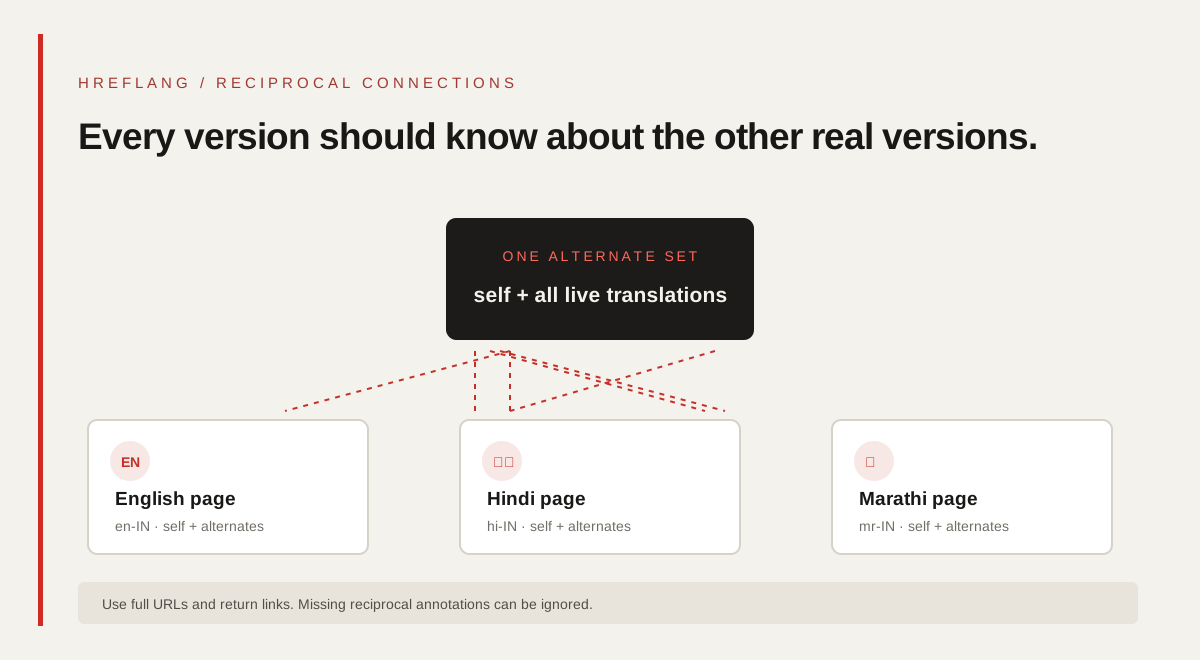
Hreflang annotations tell Google that specific URLs are language or region alternatives of the same page. They do not translate content or guarantee that Google will display a particular version. Use supported language codes, and add a region code only when it helps identify the intended audience.
Each version should list itself and the other real alternatives. The set should be consistent across pages, and the URLs should point back to one another. Google notes that missing return links can cause annotations to be ignored or interpreted incorrectly. Use fully qualified URLs, including `https://` and the host.
You can provide alternate-language annotations in HTML, HTTP headers or a sitemap. These methods are equivalent from Google’s perspective. Choose the approach that fits the site and keep one reliable source of truth; maintaining the same large set in several places can create mismatches.
| Check | What a correct setup looks like |
|---|---|
| Self-reference | The English page lists its English URL along with the available Hindi and Marathi alternatives. |
| Return links | The Hindi and Marathi pages point back to the English page and to the same real alternatives. |
| Language values | Use the correct language code, optionally followed by a valid region code, such as hi-IN. |
| Absolute URLs | Every alternate points to the full, final HTTPS URL—not a relative path or redirect. |
| Fallback | Use x-default only for a meaningful default destination or language-selection page. |
USER EXPERIENCE / LANGUAGE SWITCHING
Let visitors choose without forced redirects
Avoid automatically sending people to a different language page based only on an assumed language, IP address or browser setting. Google warns that these redirects can prevent people—and search crawlers—from viewing all language versions.
Add visible links that let people switch to another language and preserve their place in the journey when an equivalent page exists. Keep the control understandable, keyboard accessible and available on mobile. If the visitor chooses a language, do not repeatedly override that choice on the next page.
If you show a language chooser, it can be a useful fallback for visitors who do not match a specific language version. An x-default hreflang can identify that fallback to Google, but it is optional and should point to a real, helpful destination.
TECHNICAL REVIEW / AVOID SIGNAL CONFLICTS
Check the page and its signals before launch
Before launch, open each language URL directly and confirm it returns the intended page without requiring a cookie, session or language-selection interaction. Check that search crawlers are not blocked and that the correct version is available in the rendered page.
Review canonical tags so each translation points to the URL intended to represent that page; do not point every distinct language page to one English URL as a shortcut. Include only preferred public URLs in the sitemap and keep internal links and hreflang annotations aligned with the actual live versions.
Common mistakes include a one-way hreflang link, invalid language codes, a stale alternate URL, a redirect loop, a translation that changes the business offer, and boilerplate translation with little useful main content. Fix the underlying page or connection rather than adding more markup to cover the problem.
- Test every version’s status, canonical, robots access and visible content.
- Keep the language switcher, sitemap and alternate URLs pointed at final pages.
- Use URL Inspection in Search Console to check important versions after publication.
- Do not treat valid hreflang syntax as proof of indexing or ranking.
MAINTENANCE / KEEP VERSIONS ALIGNED
Measure and maintain each version separately
Track which language pages are receiving relevant impressions, clicks and enquiries. In Search Console, compare the page and query data for each URL and language; do not treat every version as identical if the search terms or audience needs differ. In analytics, respect consent settings and compare the events the site actually records.
Measure the business outcome too. A translated landing page is useful when visitors can understand the offer and take the next step—not simply because the page exists. Ask the team whether enquiries arrive in the language offered and whether follow-up is clear.
When a service, price, phone number, legal notice or process changes, update each language version and review its hreflang set. A short translation inventory with URL, language, reviewer and last content check helps prevent old versions from drifting away from the current offer.
- Keep a named reviewer for each language version.
- Review translated service details when the English source changes.
- Check Search Console by page and query rather than using a single blended site average.
- Measure qualified enquiries and successful follow-up, not only clicks.
LAUNCH / FINAL CHECKLIST
Use this checklist before publishing another language
A small, carefully maintained set of pages is usually a better starting point than translating the entire site at once.
- Is there a real customer need and a team that can support the language?
- Does each version have its own stable, crawlable URL?
- Is the main content genuinely translated and reviewed by a fluent person?
- Does each hreflang set include itself and all available alternatives with return links?
- Are canonical, sitemap, internal links and language switcher pointing to the right final URLs?
- Can visitors choose a language without being forced into an automatic redirect?
- Have you checked important URLs in Search Console without assuming indexing is guaranteed?
THE DETAILS
Questions worth
asking early.
Clear answers about multilingual seo in mumbai before you choose your next step.
Does hreflang translate my page or guarantee a better ranking?
No. Hreflang identifies language or region alternatives so Google can understand the relationship between pages. It does not translate content, guarantee that a version will be shown, or promise a ranking improvement.
Does Google use the URL or lang attribute to identify a page language?
Google says it uses visible page content to determine language and does not rely on the URL or HTML lang attribute alone. Make the page’s main content clear in its intended language.
Do English, Hindi and Marathi pages need separate URLs?
Google recommends separate URLs for different language versions rather than changing the page only through cookies or browser settings. Connect the equivalent pages with hreflang and let visitors choose between them.
What does x-default mean in hreflang?
It identifies a fallback URL for visitors who do not match a listed language or region. It is optional and is most useful for a language chooser or a suitable default page.
Does every translated page need reciprocal hreflang links?
Yes. Google’s guidance says each version should list itself and its alternate versions, and those pages should link back. Missing return links can cause annotations to be ignored or misinterpreted.