THE SHORT ANSWER
What matters most.
Build salon marketing around the services the team actually performs, the clients it can serve and the appointment capacity it has. Keep local listings accurate, publish clear service descriptions and price conditions, use permissioned photos, and make mobile booking straightforward. Social content can show the experience; local search can help people find a nearby salon; referrals can add personal context. Track confirmed and completed appointments, cancellations and return visits, while keeping private service notes out of marketing analytics. These practices can improve clarity and help a salon learn from its own results, but they cannot guarantee rankings or bookings.
QUICK REFERENCE
Key takeaways.
- KEY POINT 01Define the salon’s real service mix, location, availability and client fit.
- KEY POINT 02Explain service steps, duration, price conditions and booking requirements before a visit.
- KEY POINT 03Use accurate local business details and genuine photos that the salon has permission to publish.
- KEY POINT 04Show real work without misleading edits, unsupported beauty claims or hidden creator partnerships.
- KEY POINT 05Make appointment booking and rescheduling work clearly on a mobile device.
- KEY POINT 06Measure confirmed visits and repeat appointments—not only reach and likes.
POSITIONING / DESCRIBE THE REAL OFFER
Choose a clear position for the salon
A salon may specialise in hair, nails, makeup, styling, bridal services or a broader set of appointments. Decide which services the team wants to be known for and can deliver reliably. Mention the neighbourhood and travel context accurately; a local client usually needs a real location, opening hours and a practical way to book.
Describe the experience in specific terms: who performs the service, whether a consultation is needed, the approximate appointment duration, and what the service does and does not include. If a service has different options or a price depends on hair length, products or session scope, say so before the client arrives.
Use claims that reflect the salon’s actual training, products and results. Avoid “best salon” or guaranteed appearance claims unless they can be substantiated and are appropriate for the service. Do not suggest that a client has a personal flaw or medical condition as a way to sell an appointment.
- Select a small group of priority services and explain who they suit.
- Check the location, opening hours and appointment capacity.
- Clarify where a consultation or price estimate is required.
- Keep public service descriptions consistent with what the team provides.
SERVICE MENU / SET EXPECTATIONS
Make service menus easy to compare
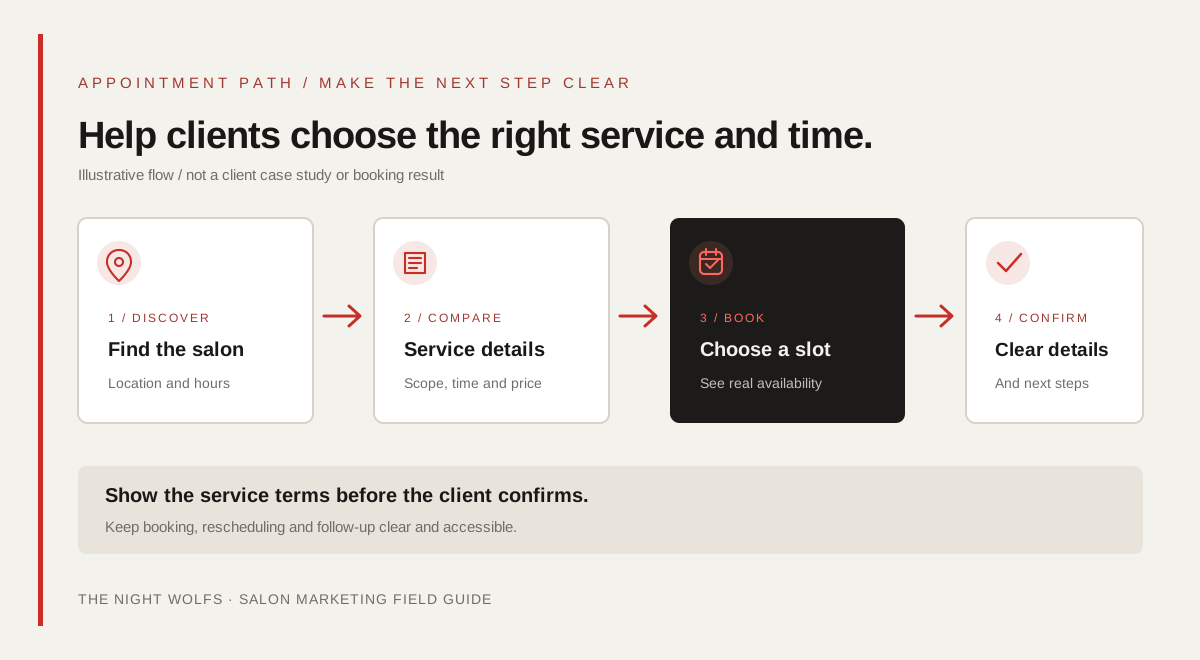
Group services so a client can scan the menu without knowing the salon’s internal terminology. Use familiar names, explain what is included, note who performs the service and state the expected duration or price basis when known. If a final quote requires a consultation, explain how that consultation works and whether it has a fee.
Make deposits, cancellation conditions, late-arrival policies and rescheduling steps visible before a client confirms. If a price is shown as “from,” explain what changes the final cost. Clear conditions make it easier for a client and the reception team to avoid surprises.
Keep service information current across the website, booking platform, local profile and social links. Remove services the team no longer offers and make limited availability clear. A complete menu should answer real client questions, not repeat a search phrase in every description.
LOCAL SEARCH / HELP NEARBY CLIENTS FIND YOU
Keep the salon’s local listing accurate
If the salon is eligible for a Google Business Profile, use its real-world name and the correct address, category, phone, hours and website or booking link. Google’s guidelines say the profile name should reflect the real-world business name. Do not add a neighbourhood list or service keywords to the name just to influence search results.
Make sure the map pin brings a client to the actual entrance and that any booking link opens the right location and service options. Update holiday hours, temporary closures, phone numbers and appointment links when they change. Use current images and avoid presenting another salon’s work as your own.
Google describes local visibility using relevance, distance and prominence; profile accuracy helps people evaluate the business but does not guarantee a particular result. Invite honest client feedback without incentives for positive ratings, and reply without exposing private appointment or service details.
- Use the salon’s genuine name, address and service category.
- Confirm the map pin, operating hours, phone and booking URL.
- Update service information and photos when the offer changes.
- Request honest reviews without buying, filtering or scripting ratings.
WEBSITE / ANSWER SPECIFIC SERVICE QUESTIONS
Create useful pages for priority services
A service page should explain what the appointment involves, what is included, how long it may take, any preparation the client should know about, and how to book. Add a price or pricing method where possible. If a service requires a consultation first, make that the clear next step rather than sending the visitor to a generic contact page.
Use pages for genuinely distinct services, not near-identical versions that only swap neighbourhood names. Include the salon’s real location and nearby context where it helps a client plan a visit. Google’s image guidance recommends descriptive alt text and placing images near relevant information; write alt text for the image itself rather than stuffing it with keywords.
If a service is clinical, health-related or otherwise regulated, describe only services the provider is qualified and permitted to offer. Avoid medical claims on a general salon page and direct a person with a health concern to an appropriately qualified professional.
VISUAL CONTENT / SHOW REAL WORK
Use authentic visuals and clear permissions
Photos and short videos can help a client understand the salon’s style, setup and work. Use images of the actual salon or service with permission. If a creator, stylist or client appears, agree where the content will be used and for how long. Do not share identifiable client information or private messages without permission.
Avoid filters, retouching or lighting changes that materially alter the result. Before-and-after images should use comparable framing and lighting and should not imply that an exceptional outcome is typical. The ASCI Code calls for truthful advertising claims and safeguards against misleading representations.
If an influencer or creator receives payment, a free service or another benefit, disclose the material connection clearly as required by current ASCI and platform guidance. A genuine experience is more useful than a scripted testimonial that hides the commercial relationship.
- Use current photos of the salon and work the team performed.
- Get permission before publishing client or creator images.
- Keep before-and-after context honest and avoid edits that misrepresent results.
- Disclose paid or gifted creator partnerships clearly.
CHANNEL MIX / GIVE EACH FORMAT A JOB
Match each channel to a useful client action
Local search can help a nearby client compare salons and locate a service. Social posts can show work, introduce a stylist or answer preparation questions. Referrals can add personal context, and a booking platform can handle schedule availability. These channels overlap, but each needs a destination that matches what the post or listing promises.
Use the table as a starting test, not a platform ranking. Choose a pace the team can sustain, keep details accurate and compare completed appointments and fit alongside views or clicks.
| Channel | Useful role | Connect it to |
|---|---|---|
| Google Search and local profile | Help nearby clients discover and evaluate the salon. | Accurate location, service and appointment details. |
| Instagram or short video | Show real work, the salon experience or a stylist’s process. | A relevant service page or booking option. |
| Creator partnership | Introduce the salon to a creator’s relevant audience. | A genuine visit and clear sponsorship disclosure. |
| Referral | Help a current client recommend the salon to someone they know. | Transparent terms and an easy booking route. |
| Email or WhatsApp | Send opted-in updates, confirmations or useful reminders. | Client permission, relevant timing and opt-out choices. |
| Paid campaign | Test a specific service or appointment offer. | A matching page, available slots and an accurate offer. |
BOOKING / REDUCE AVOIDABLE FRICTION
Make the appointment path simple on mobile
A client should be able to choose a service, stylist if available, location, date and time without repeatedly entering the same details. Show the duration, price basis and booking conditions near the available slots. If a consultation is needed before confirming a service, make that step clear.
Test confirmation, cancellation and rescheduling on a phone. When a slot is no longer available, preserve the client’s service choice and offer a clear next step. Send the confirmation to the contact method the client provided and make it easy to ask a question or change the appointment.
Keep the form short and accessible: label fields, explain errors, make time options readable and provide a keyboard-friendly flow. Do not require a marketing opt-in as a hidden condition of booking.
CLIENT CARE / PROTECT PRIVATE DETAILS
Separate appointment operations from marketing
Collect only the information needed to schedule and deliver the service. Explain how appointment details will be used and who may contact the client. Ask separately before sending ongoing promotions, and honor the client’s opt-out.
Some services may involve private preferences or sensitive personal information. Keep those details within the salon’s appropriate service workflow and limit access to staff who need them. Do not place a client’s name, phone number, service notes or personal concerns into analytics events, campaign URLs or public replies.
Use the booking platform or salon system to manage confirmations and changes, and assign a real person to review unanswered questions. An automated message should identify what it can handle and how the client can reach staff.
RETENTION / MAKE FOLLOW-UP RELEVANT
Encourage return visits without over-messaging
After an appointment, give the client a useful way to ask a follow-up question or book again. Timing may depend on the service and individual preference, so avoid treating one fixed reminder schedule as right for everyone. Let clients control promotional messages and provide a simple way to stop them.
A referral request or review invitation should be neutral and honest. Do not reward only positive reviews, pressure clients to change a fair review or publish a response that reveals their service history. Use feedback internally to identify recurring issues and improve the appointment experience.
Keep the salon’s team aligned on who owns rebooking questions, service complaints and schedule changes. Helpful follow-up supports client trust; it does not guarantee repeat business.
MEASUREMENT / COUNT APPOINTMENTS THAT HAPPEN
Measure completed appointments, not just attention
Track useful steps from discovery to the salon visit: service-page views, booking starts, confirmed appointments, completed visits, cancellations and return bookings. Define these stages consistently so a new campaign can be compared with the salon’s own previous activity.
Use campaign tags where appropriate and consent-aware website analytics. Keep personal details out of links and analytics data. Compare the time and spend required for each channel with appointment quality and service fit; a large number of clicks is not the same as a full, profitable schedule.
Review missed appointments and reschedules alongside booking volume. If clients often choose the wrong service, improve menu descriptions. If they abandon after selecting a time, check availability, price visibility, deposits and the confirmation flow before increasing media spend.
| Signal | Question for the salon |
|---|---|
| Service-page visits | Are people reaching information that matches the service they want? |
| Booking starts | Is the booking option visible and understandable? |
| Confirmed and completed visits | Do booked appointments fit the salon’s services and capacity? |
| Cancellations and reschedules | Are policies, reminders and available slots clear? |
| Return appointments | Do clients choose to book again on their terms? |
ACTION PLAN / A FOUR-WEEK START
Use a four-week plan to improve bookings
Start with one priority service and the appointment path attached to it. A focused review is easier to maintain than a rushed push across every channel.
- Week 1: confirm priority services, price conditions, location, schedule and capacity.
- Week 2: improve the local profile and one service page with current photos.
- Week 3: publish a useful visual post and test the mobile booking path.
- Week 4: compare confirmed visits, completed appointments and cancellations.
- Assign a clear owner to booking questions, profile updates and follow-up.
This is a practical workflow, not a promise of first-page rankings or a particular number of appointments.
THE DETAILS
Questions worth
asking early.
Clear answers about salon marketing in mumbai before you choose your next step.
How can a salon in Mumbai get more appointments?
Make service details, location, price conditions and available times easy to understand. Keep local listings accurate, show authentic work and make the booking path work on mobile. Track confirmed and completed appointments to find where the experience needs improvement.
What should a salon list on its Google Business Profile?
Use the real-world business name, accurate address, category, phone, hours, website or booking link and current photos. Keep service details updated and follow Google’s current eligibility and representation guidelines.
Should a salon post before-and-after photos?
Only with permission and clear, accurate context. Avoid edits or different lighting that materially change the impression, and do not suggest an exceptional result is guaranteed or typical without support.
Which social platform is best for salon marketing?
It depends on the salon’s clients, content capacity and service. Use a platform the team can maintain, publish authentic work and connect each post to a relevant service or booking path. Compare completed appointments, not only views.
Can salon marketing guarantee top Google rankings?
No. Search results depend on many factors, and no profile, page or campaign can guarantee a particular position or appointment volume. Focus on accurate details, useful service pages and a dependable booking experience.
SOURCES & FURTHER READING
- Google Business Profile Help — Guidelines for representing your business (opens in a new tab)
- Google Business Profile Help — Tips to improve your local ranking on Google (opens in a new tab)
- Google Search Central — Image SEO Best Practices (opens in a new tab)
- Advertising Standards Council of India — The ASCI Code (opens in a new tab)
- ASCI — Guidelines for Influencer Advertising in Digital Media (opens in a new tab)