THE SHORT ANSWER
What matters most.
Start with a specific customer problem and the product’s verified fit. Make the demo or trial experience clear, publish useful answers for the buying team, assign a real owner to every qualified enquiry and help new accounts reach a meaningful first-use moment. Define lead stages with sales, measure product and pipeline milestones consistently, and review customer quality and retention alongside acquisition. A process can make learning clearer, but no channel or framework guarantees a particular growth rate.
QUICK REFERENCE
Key takeaways.
- KEY POINT 01Choose a specific buyer, use case and problem the product can actually solve.
- KEY POINT 02Show verified product workflows instead of broad claims or fabricated customer results.
- KEY POINT 03Make pricing, demo, trial, integration and support expectations easy to understand.
- KEY POINT 04Route every serious enquiry to a named owner with a useful next step.
- KEY POINT 05Connect account creation and product activation with qualified pipeline and paid conversion.
- KEY POINT 06Measure retained customers and fit, not only leads or demo bookings.
POSITIONING / CHOOSE A SPECIFIC USE CASE
Define the customer and problem the product solves
“Businesses that want to grow” is not enough to make a SaaS marketing plan. Describe the organizations, roles, workflow and trigger that make the product a sensible fit. A tool for finance teams, a CRM for a defined sales process and a scheduling product for service businesses need different examples, pages and sales conversations.
Write a short fit statement: who uses the product, what recurring job they are trying to complete, what they do today and what must be true for your product to help. Confirm the statement with customer interviews, support questions, implementation notes, sales calls and product usage—not only internal assumptions.
A SaaS company based in Mumbai may sell to local firms, Indian organizations across multiple regions or international customers. Do not assume geography determines need. Track the role, organization type, use case and service region only when that information has a clear business purpose.
- Name the user, buyer and operational problem separately when they differ.
- Identify the situations where the product is not a good fit.
- Use actual customer questions to validate terminology and priorities.
- Keep targeting and qualification criteria specific enough for sales and marketing to share.
MESSAGE / CONNECT CAPABILITY TO PROOF
Explain what the product does—and what supports the claim
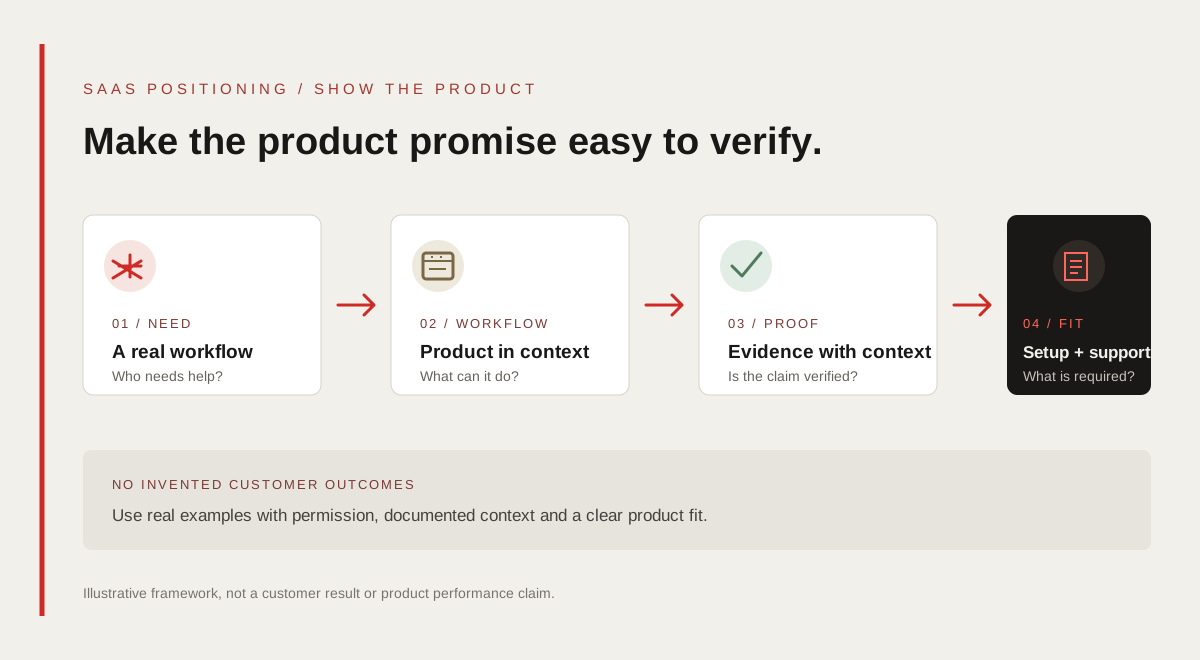
A product promise should describe a real workflow or customer task. Explain what the user can do, what information or setup is required, where people still make decisions and which plan or integration is needed. Avoid vague “all-in-one” language unless the product’s actual scope supports it.
Use screen recordings, a guided walkthrough or a sample workspace to show the product in context. Label demo data as illustrative. If an example uses real customer information, get permission and remove details that should not be published.
Use customer outcomes only when the customer approved the case study and the figures are documented, current and presented with context. A result from one organization is not a promise that every customer will get the same outcome. Do not manufacture logos, endorsements or product comparisons.
CONVERSION PATH / MATCH THE WAY PEOPLE EVALUATE
Choose a demo, trial or consultation that fits the product
A self-serve trial can help when a buyer can safely create an account, understand the core workflow and assess fit without extensive setup. A guided demo may be more useful when implementation, integrations, permissions or team configuration need explanation. A discovery conversation can be the right first step when requirements vary widely.
Tell visitors what happens after they submit a request or start a trial. State whether a call is required, what information the team may ask for, whether the trial has a time limit, what happens when it ends and how a user can get help. Do not call a trial “free” without clearly explaining any conditions that affect access or later charges.
Choose one primary next step for each page. A product evaluation page can offer a demo or trial, while a deeper technical page may invite an architecture discussion. Avoid presenting multiple competing buttons without explaining which one suits which visitor.
| Evaluation path | Can fit when | Make clear |
|---|---|---|
| Self-serve trial | The core workflow is easy to explore without assisted setup. | Included features, duration or limits, data handling and what happens at the end. |
| Guided demo | A buyer needs to see a workflow or ask product questions with a team member. | Who will attend, what will be shown and what the next step may be. |
| Consultation | Requirements, integrations or implementation need an initial discussion. | The purpose of the conversation and the information the team actually needs. |
CONTENT / HELP PEOPLE EVALUATE
Publish answers for the whole buying group
SaaS evaluation can involve an end user, department lead, IT reviewer, finance approver or business owner. Each person may ask a different question: Does it fit the workflow? Can it connect to existing systems? What can administrators control? What does the plan include? How does the company support customers?
Build pages around genuine questions from demos, support tickets, onboarding and product documentation. Useful content might include a product overview, a specific use-case guide, a setup checklist, integration details, security information, pricing terms and a fair comparison where the differences are verified.
Keep pages distinct and useful rather than publishing many near-identical pages for each industry or city. Google Search Central’s guidance emphasizes helpful, reliable, people-first content. A Mumbai location page should explain a real local service or support offer—not simply add “Mumbai” to generic copy.
- Use a product page to explain the core workflow and intended user.
- Create use-case pages only when the product and evidence differ meaningfully.
- Give technical reviewers access to current integration and security information.
- Maintain pricing, plan limits and comparison details when the product changes.
DISTRIBUTION / BUILD A TESTABLE PIPELINE
Give each acquisition channel a clear role
Choose channels based on how the intended buyer discovers and evaluates the product, the company’s ability to maintain the work and the budget available for a useful test. Search can support active problem research; LinkedIn or other professional communities can help reach defined roles; useful product education can support longer evaluation; partners can introduce the product to organizations they already serve.
A channel list is not a strategy unless each route has a clear audience, content or offer, destination page, follow-up owner and measurement plan. Start with a manageable mix and make sure the team can respond to the demand it creates.
| Channel | Possible role | Check before expanding |
|---|---|---|
| Search and SEO | Answer a problem or product question when a buyer is researching. | Query fit, useful page content and a clear next action. |
| Professional social | Share product education with relevant roles and organizations. | Audience fit, useful creative and a repeatable publishing owner. |
| Paid campaigns | Test a defined audience, offer or search need with controlled spend. | Working conversion measurement and the capacity to qualify enquiries. |
| Partners and events | Reach a relevant group through a credible introduction or discussion. | A clear shared value, consented follow-up and a named relationship owner. |
| Continue a product conversation with people who asked to hear from you. | Permission, relevance and an easy way to manage communication choices. |
CONVERSION / DESIGN THE NEXT CONVERSATION
Make the demo or trial request easy to complete
A demo request form should collect enough information to prepare a useful conversation, not a full procurement file. Ask for the contact route, organization and use case only when those details help route or prepare the request. Explain optional questions and avoid requesting sensitive data that does not belong in a marketing form.
After submission, confirm that the request was received and say what the team will do next. Assign an owner, record the source and use a response expectation the team can actually meet. If availability depends on team schedules or support hours, state that rather than promising an instant reply.
Test the complete path on a phone and desktop: validation errors, confirmation, calendar booking, notifications, CRM creation and the handoff to a sales or product specialist. Preserve entered form details when a correctable error occurs and ensure a successful request does not vanish into an unmonitored inbox.
SALES HANDOFF / USE SHARED DEFINITIONS
Agree on lead stages before counting pipeline
Lead labels vary across companies. Agree on what “qualified” means for this product: perhaps the organization matches the intended use case, a relevant person is involved, the need is real and a plausible next step exists. Record the reason for a poor fit as useful feedback rather than treating every rejected enquiry as a marketing failure.
Map the company’s actual journey from initial response to evaluation, opportunity, purchase or a clear no-fit outcome. Assign a person to update each stage and decide how often sales and marketing review the handoff. If a product-led trial can become a sales opportunity, define what product activity prompts a helpful conversation without surprising or pressuring the user.
Google Ads distinguishes an initial lead from a qualified lead and a converted lead, with qualification or conversion often recorded from a CRM or internal lead system. The terminology can help teams think beyond a form fill, but adopt definitions that reflect your own sales process.
- Document the criteria and owner for each lead stage.
- Separate invalid, duplicate, unresponsive and not-a-fit enquiries.
- Feed useful fit and objection patterns back into product pages and campaigns.
- Do not label an account qualified only because it booked a call.
ONBOARDING / HELP THE ACCOUNT GET STARTED
Connect acquisition to onboarding and first value
A new account still needs to understand how to begin. Make the first-use instructions, roles, permissions, integrations, sample data and support options easy to find. Tailor the onboarding path to the product’s core job rather than measuring success only by a completed signup.
Define a meaningful activation milestone with the product team. It might be a user completing a core workflow, connecting a required data source or inviting a teammate, depending on what predicts an account can use the product. Treat it as a working internal definition and validate it against customer outcomes before using it to make claims.
Use onboarding messages to remove barriers and answer product questions. Keep them relevant to the account’s stated use case and communication preferences. If a trial expires or a feature requires a paid plan, explain that clearly and give the customer a way to make an informed choice.
MEASUREMENT / TRACK THE STAGES THAT MATTER
Measure marketing through product and revenue stages
Google Analytics recommends events for actions such as `generate_lead`, `sign_up` and `close_convert_lead`. They represent different stages: an initial demo request or lead, account signup, and a qualified lead that becomes a customer. Use event names only when they match the action that actually occurred, and do not count a button click as a completed signup or paid subscription.
Connect website activity with product analytics and the CRM using stable, privacy-appropriate identifiers and documented definitions. Keep personal contact information out of Google Analytics event names, URLs and parameters. Respect the site’s consent choices and the applicable rules for marketing communications and data collection.
Review the path as a funnel and as a cohort: relevant visit, demo or trial, qualified opportunity, activated account, paid customer and retained account. A long sales cycle or usage lag can delay what the dashboard shows, so compare consistent cohorts and note changes to the product, offer, sales process and pricing.
| Stage | Question for the review |
|---|---|
| Relevant visit | Did the organization and use case match the intended customer? |
| Demo or signup | Did the person complete the requested evaluation step? |
| Qualified opportunity | Did the team verify need, fit and a meaningful next action? |
| Activation | Did the account reach the product milestone defined by the team? |
| Paid and retained | Did the customer start and continue a suitable subscription? |
ACTION PLAN / FOUR WEEKS TO A BASELINE
Build a focused first-month marketing plan
A first-month plan should test whether the product story, evaluation path and handoff make sense. It is not a promise that a B2B SaaS sale will close within a month. Keep the scope small enough that the team can review the evidence and improve the next step.
- Week 1: define the target use case, qualification criteria and product proof.
- Week 2: improve one product or use-case page and test the demo or trial path.
- Week 3: run a focused channel test with a named follow-up owner.
- Week 4: review lead fit, demos, activation issues, pipeline stage and customer questions.
- Log what to keep, change or stop before increasing the campaign scope.
Use the review to find friction the company can address—unclear fit, missing technical answers, slow handoffs or onboarding gaps—before assuming that more traffic is the answer.
THE DETAILS
Questions worth
asking early.
Clear answers about saas marketing in mumbai before you choose your next step.
What is SaaS marketing?
SaaS marketing helps an organization discover, evaluate, adopt and continue using software delivered as a service. It connects product positioning and content with demos or trials, sales follow-up, onboarding and customer outcomes.
Should a SaaS company offer a free trial or a demo?
Choose the path that fits how buyers evaluate the product. A trial can suit a product people can explore independently; a demo or consultation can help when setup, integrations or requirements need explanation. Make conditions and next steps clear.
How should a SaaS team define a qualified lead?
Agree on criteria with sales that reflect product fit, organization, use case, need and a plausible next step. There is no universal definition that fits every SaaS business.
Which SaaS marketing events can Google Analytics measure?
Google documents events including generate_lead for initial leads, sign_up for account creation and close_convert_lead when a qualified lead becomes a customer. Implement them only when they match real actions, and validate the data.
How can SaaS marketing and sales work together?
Share the target customer, qualification criteria, stage definitions and follow-up ownership. Review sales objections, no-fit reasons and onboarding friction together so product pages and campaigns reflect what buyers actually need.
Can a SaaS marketing plan guarantee demos or revenue?
No. A plan can help a team test its message and customer journey, but results depend on product fit, timing, competition, pricing, sales execution, onboarding and other factors.