THE SHORT ANSWER
What matters most.
Decide what a qualified enquiry means, use consistent UTM names on campaign links, and carry source details into the CRM where they can be reviewed by the team. Label forms, calls and WhatsApp clicks according to what each event actually confirms. Keep personal information out of analytics URLs, compare platform reports cautiously, and use qualified or completed outcomes—not every tap—as the basis for better decisions.
QUICK REFERENCE
Key takeaways.
- KEY POINT 01Define the difference between a contact action, a qualified enquiry and a completed business outcome.
- KEY POINT 02Use consistent utm_source, utm_medium and utm_campaign values for campaign links you control.
- KEY POINT 03Keep campaign names in analytics tags; store lead identity and follow-up details in an appropriately protected CRM.
- KEY POINT 04Count a form success, phone call and WhatsApp click as different actions with honest labels.
- KEY POINT 05Preserve the original campaign source and the latest useful touch when your CRM can support both.
- KEY POINT 06Compare campaign reports with sales follow-up and customer feedback; attribution is evidence, not perfect proof of causation.
MEASUREMENT / DEFINITIONS
Agree on what counts as a useful lead
A click is not a lead, and a form submission is not automatically a qualified opportunity. Before choosing tracking tools, write down the stages the business actually uses: new enquiry, contacted, qualified, appointment or consultation, proposal, and won or lost. A small team may need fewer stages, but each one should have a clear meaning and an owner.
For a Mumbai service business, qualification might depend on the requested service, a location the team can serve, timing and a suitable next step. For a clinic, retailer or property team, the criteria will differ. Ask the people who handle enquiries what information helps them decide whether they can assist; do not add fields merely because a CRM makes them available.
Keep the event name honest. A form confirmation can show a successful submission. A click on a phone number shows intent to call. A click that opens WhatsApp does not prove that a message was sent, read or answered. Reports become more useful when the label says exactly what the system observed.
| Observed action | What it confirms | What it does not confirm |
|---|---|---|
| Campaign link click | A tagged link was opened | That the visitor became a lead |
| Successful form submission | The website accepted a submission | That the request fits the service |
| WhatsApp button click | The visitor selected an outbound chat link | That a conversation or sale followed |
| Qualified CRM stage | The team applied its agreed fit criteria | That the opportunity will close |
WEBSITE / CRM HANDOFF
Carry campaign context into the enquiry record
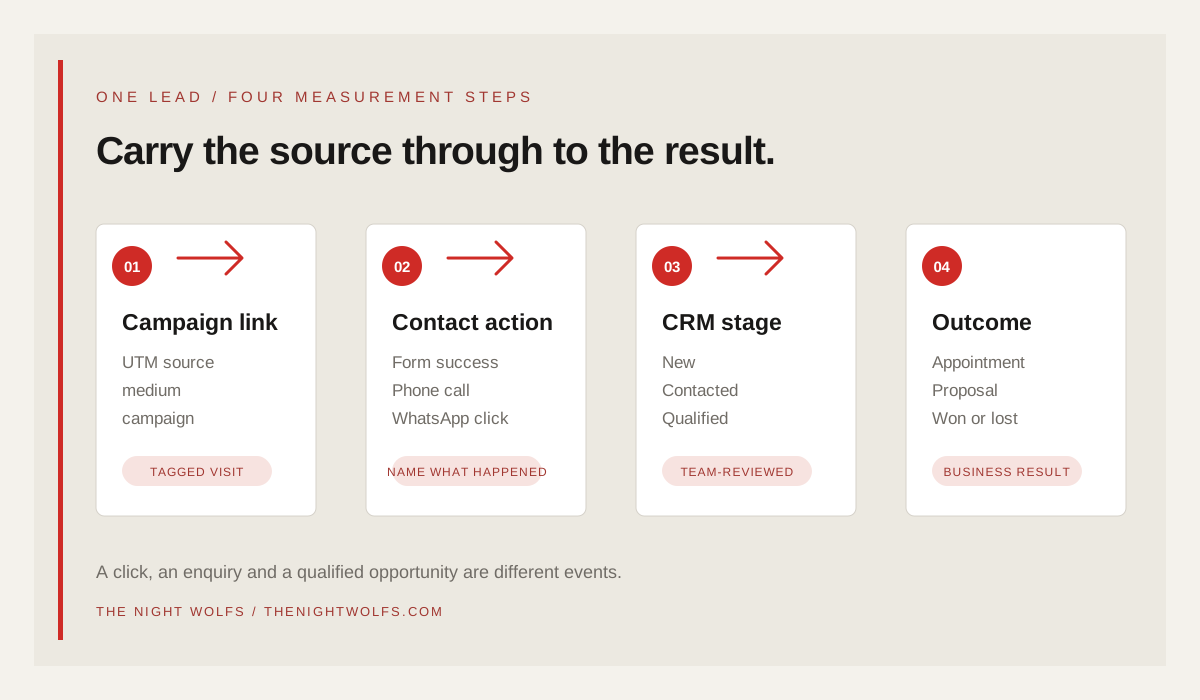
A campaign report is easier to use when the enquiry-handling team can see the same source context. Where the website and CRM setup supports it, preserve campaign fields such as source, medium, campaign, landing page and the time of the first visit alongside the enquiry record. A later interaction can be stored separately as a recent touch rather than overwriting the original source.
Use a stable internal lead ID to connect follow-up stages. If the same person submits twice, define whether the CRM updates the existing record or creates a new enquiry and how the source history is retained. Avoid sending a raw email address, phone number or name in URL parameters or analytics events. Google’s Analytics guidance says URLs and campaign dimensions should not contain personally identifiable information; keep identity and contact details in systems designed to handle them.
Attribution will still have gaps. A visitor may use another device, clear cookies, call from a different phone or hear about the business from someone else. A neutral question such as “How did you hear about us?” can add a self-reported source to the record. Label it as customer-reported rather than blending it with a tracked digital source.
CONTACT / EVENT DEFINITIONS
Measure forms, calls and WhatsApp as different events
For a web form, fire the success event only after the server or application confirms that the submission was accepted. A button click, required-field error or form start is not the same event. Test one valid submission, one invalid submission and a repeat visit so the reports do not count an unsuccessful attempt as a completed enquiry.
For phone leads, distinguish a tap on a telephone link, an answered call and a call that the team marks as relevant. Google Ads provides call-conversion options for eligible accounts and markets; check the current country, number and account requirements before selecting a platform feature. A call duration threshold can be a useful proxy, but it does not establish whether the caller was a good fit.
For WhatsApp, record the outbound click as a click event and name it that way. It is an intent signal, not proof that a visitor sent a message or became a lead. If the conversation becomes an enquiry, record the outcome in the CRM with the source context available to the team. Avoid putting customer details in a prefilled link or campaign URL.
- Form: successful submission after validation and acceptance.
- Phone: number click, connected call and qualified call are separate stages.
- WhatsApp: outbound click, conversation started and qualified enquiry are separate stages.
- CRM: record the human-reviewed qualification and follow-up result.
REPORTING / CLOSED LOOP
Connect campaign activity to qualified CRM outcomes
A practical measurement loop needs a campaign record, a contact event and a clear CRM stage. Agree which system owns each fact: Analytics can describe website events and campaign parameters, the ad platform can report its own interactions, and the CRM can record whether the team contacted, qualified or closed an enquiry. Do not expect the totals to match exactly; their definitions, consent settings and attribution windows can differ.
Review qualified enquiries alongside raw submissions. If one campaign produces many clicks but few service-fit requests, check the audience, promise, landing page and response path before increasing spend. If a campaign attracts fewer but more suitable leads, the CRM stage and follow-up quality may tell a more useful story than a platform’s click count.
If the team later sends qualified or closed lead outcomes back to an advertising platform, follow that platform’s current eligibility, consent and data-handling requirements. Google’s documentation describes enhanced conversions for leads and notes changes to its upload pathway in 2026. Check the current account guidance before building an integration; do not copy an old API recipe from an outdated tutorial.
ANALYSIS / LIMITS
Compare attribution reports without treating them as proof
First-touch reporting asks which recorded source appeared earliest; last-touch reporting asks which source was most recent before the recorded action. Both can answer useful questions, but neither describes every influence on a decision. A person may see an Instagram reel, search the brand later, compare options, ask a colleague and then call directly.
Choose a reporting view that matches the question. Use campaign tags to compare tagged traffic, CRM stages to compare lead quality, and a short customer-reported source question to capture influence that analytics may miss. If two platforms both claim a conversion, state which model or report you are using instead of adding those claims together.
Compare like with like: similar locations, service offers, time periods, lead definitions and follow-up capacity. Note major changes such as a new landing page, a seasonal campaign or a different response process. These notes make a month-to-month comparison more honest than a single “best channel” ranking.
| Question | Useful evidence | Caution |
|---|---|---|
| Which campaign sent tagged visits? | Consistent UTMs and Analytics acquisition reports | Untaged or cross-device visits may be missing |
| Which channel created qualified enquiries? | CRM source fields and agreed qualification stages | Source capture and staff follow-up must be consistent |
| Which ad platform reports a conversion? | That platform’s conversion report and settings | Different attribution windows can claim the same journey |
| What influenced the decision? | Customer-reported source plus recorded interactions | Recall is useful context, not a complete history |
OPERATIONS / REVIEW
Use a repeatable lead-tracking check
A small recurring check catches broken links and reporting drift before teams make a budget decision from incomplete numbers. Assign one owner for campaign naming, one owner for CRM stages and a person who can test the website’s enquiry paths. Keep the checklist short enough to run after a website, form, tag or campaign change.
- Open a tagged campaign URL on mobile and confirm the destination and campaign values are correct.
- Submit a test form and confirm one accepted submission creates one correctly sourced CRM record.
- Test the phone and WhatsApp links; confirm the event is named as a click or call action, not as a qualified lead by default.
- Review how duplicate enquiries, direct visits and customer-reported sources are recorded.
- Compare platform events with CRM stages and note any missing or delayed outcomes.
- Check consent behavior and make sure URLs, page titles and Analytics events do not include personal contact details.
- Re-check the platform’s current import instructions before sending qualified or closed lead data back to ad systems.
The useful result is not a perfect attribution score. It is a shared view of what the tracking saw, what the team confirmed and which uncertainties remain before the next campaign decision.
THE DETAILS
Questions worth
asking early.
Clear answers about lead source tracking in mumbai before you choose your next step.
Do UTM parameters show exactly where every lead came from?
No. They label campaign links that were tagged and opened. Cross-device activity, untagged links, privacy choices and offline conversations can leave gaps, so use CRM follow-up and a customer-reported source as complementary evidence.
Can a WhatsApp button click be counted as a lead?
It can be recorded as an outbound click or intent event, but the click alone does not confirm that a message was sent, a conversation began or the enquiry qualified. Keep those stages separate.
Should I put a customer’s phone number or email in a UTM?
No. Keep personal details out of campaign parameters, page URLs and Analytics events. Store contact details in an appropriately protected lead system and review the platform’s current data policies.
Which attribution model should a small business use?
Start with a consistent tagged source, a clear CRM qualification stage and a customer-reported source question. Choose first-touch, last-touch or a platform model to answer a specific question, and state the limits rather than treating one model as the whole customer journey.
SOURCES & FURTHER READING
- Google Analytics Help: URL builders and UTM campaign parameters (opens in a new tab)
- Google Analytics Help: Best practices to avoid sending PII (opens in a new tab)
- Google Ads Help: Measure calls from ads (opens in a new tab)
- Google Ads Help: About enhanced conversions for leads (opens in a new tab)
- Google Ads Help: About offline conversion imports (opens in a new tab)