THE SHORT ANSWER
What matters most.
Plan hotel marketing in Mumbai around the guest, property and booking journey. Build room pages with accurate amenities, occupancy, current photographs and clear rate conditions. Keep local business details correct, create useful guides to the hotel’s actual area, and make mobile booking straightforward. Compare the role and economics of the direct site, online travel agencies, search, maps and referrals using the hotel’s own costs and booking records; do not assume one channel always wins. Respect guest privacy, ask for honest reviews and avoid unsubstantiated claims about location, availability or experience. These practices can support discovery and trust, but do not guarantee rankings or reservations.
QUICK REFERENCE
Key takeaways.
- KEY POINT 01Choose the guest types, trip purposes and seasons that fit the property and its real capacity.
- KEY POINT 02Make room pages answer questions about occupancy, amenities, location and inclusions.
- KEY POINT 03Show rate conditions, taxes or additional charges, cancellation terms and payment steps before checkout.
- KEY POINT 04Keep hotel profile details and booking links accurate across the property’s channels.
- KEY POINT 05Compare direct, OTA and referral bookings by net contribution and guest fit—not room revenue alone.
- KEY POINT 06Measure enquiries, confirmed stays and cancellations while keeping guest data private.
POSITIONING / START WITH THE PROPERTY
Define which guest and trip fit the hotel
A property may serve business travellers, families, longer stays, event guests, airport connections or weekend visitors. The best description depends on the hotel’s actual location, rooms, facilities, service hours and capacity. Write down the guest questions the front desk answers most often and use them to shape the website.
Explain what makes the property useful without leaning on generic superlatives. Name the neighbourhood accurately, describe the room types and share practical details such as check-in times, accessibility information, dining hours or transport options when they are current. If a feature is seasonal or limited, state that instead of making it sound available all the time.
The aim is not to exclude every other traveller; it is to help a visitor quickly decide whether the property fits this trip. A clear fit can reduce avoidable enquiries and make later comparisons more meaningful.
- Describe the property type, real location and room inventory accurately.
- Identify important guest needs, trip purposes and seasonal demand patterns.
- Confirm amenities, hours and service conditions with the operating team.
- Use claims the hotel can substantiate and keep them current.
ROOM PAGES / ANSWER THE GUEST QUESTIONS
Make room options easy to compare
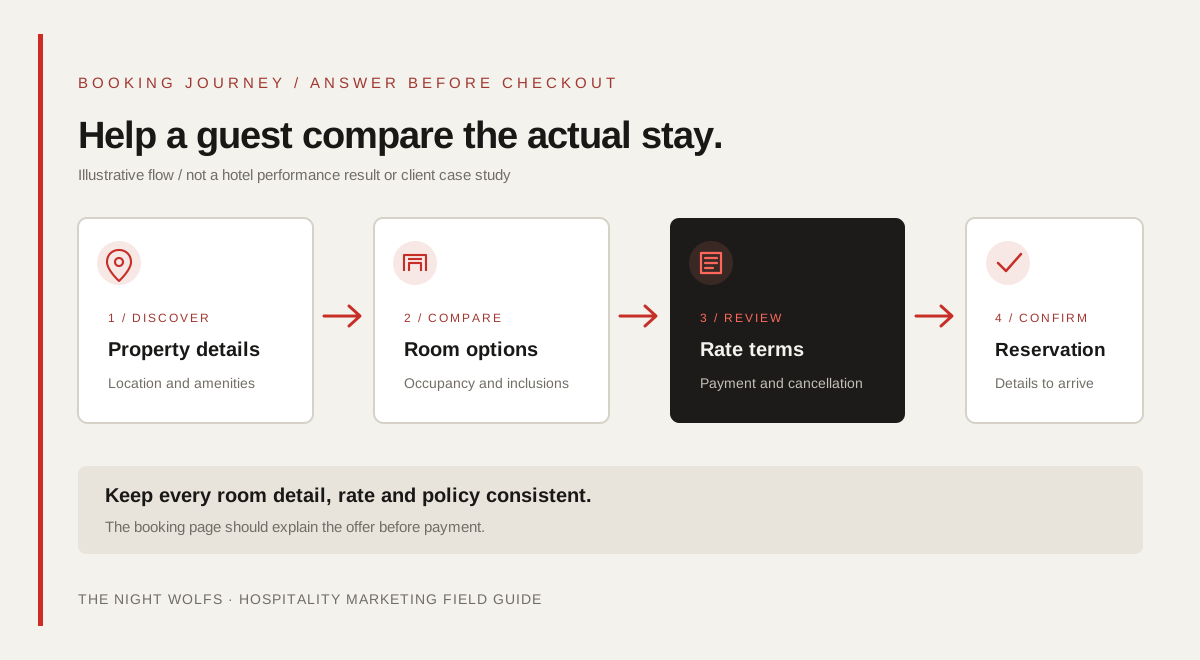
Give each meaningful room or suite type a clear name and useful description. State the standard occupancy and any maximum occupancy, bed configuration, room size when verified, accessible features, view or facilities only when they match the actual inventory. If a room has different variants, explain the difference instead of using one vague description for all.
Use current photographs that represent the room. Label views and room types accurately, keep images large enough to inspect, and avoid edits that make a room appear substantially different. Descriptive alt text can explain meaningful details to people using assistive technology; it is not a place to repeat location keywords.
A visitor should be able to compare room choices without opening multiple unrelated pages. Keep availability and pricing connected to the booking system, and make it easy to return to the room information if the guest changes dates or occupancy.
RATES / MAKE THE TOTAL TERMS CLEAR
Show the conditions before the guest pays
Explain what a displayed rate includes and excludes. Make applicable taxes, meal plans, additional charges, payment requirements, deposit rules, cancellation deadlines and refund conditions visible before checkout. If a rate is non-refundable or has a different change policy, make that difference easy to notice.
Keep “free” claims accurate and do not conceal a mandatory cost in a later step. The Advertising Standards Council of India’s code calls for truthful representations and cautions against misleading advertising; make sure offer copy matches the current booking conditions.
Check that prices and availability on the hotel website agree with the booking engine and the information sent to external channels. If the booking engine fails or a rate has changed, give the visitor a clear recovery path rather than an unexplained error.
- State the total rate basis, inclusions and mandatory charges clearly.
- Put cancellation, refund and payment conditions beside the relevant option.
- Remove expired promotions and outdated rates from pages and campaign links.
- Test date, occupancy, room and checkout changes on a phone.
LOCAL DISCOVERY / REPRESENT THE PROPERTY
Keep hotel listings and booking links accurate
Google Business Profile’s hotel guidance explains that hotel prices and booking links may come from Google Hotel Ads and free booking links. Check the property details, room information and booking destination that guests see, and contact the relevant provider if a displayed rate or link is wrong.
Keep the public property name, address, phone, category, operating details and website link consistent with the hotel’s real-world information. Do not add extra neighbourhood phrases to the hotel name or claim to be near a landmark if the location does not support that description. A wrong pin or stale booking link can create a poor arrival or checkout experience.
Do not assume that one profile change guarantees a local ranking. Google describes local visibility in terms that include relevance, distance and prominence; the hotel can control the accuracy and usefulness of its own information, but not the exact result a traveller will see.
- Verify the map pin, address, phone and official site link.
- Check booking destinations and rate details on supported hotel listings.
- Update temporary closures, seasonal hours and property amenities.
- Use genuine photos and respond to reviews without exposing guest details.
DISTRIBUTION / USE CHANNELS FOR THEIR JOB
Compare the role of each booking channel
A direct site gives the hotel control over its own information and guest communication. Online travel agencies can provide discovery and booking infrastructure under their own terms. Search and maps can help a traveller find a property, while referrals, events and social channels may introduce a hotel to a particular audience.
Compare channels using the hotel’s actual agreement, acquisition cost, payment terms, cancellation pattern, guest fit and operating workload. Avoid broad claims that direct bookings are always cheaper or that an OTA should be removed. A channel that brings new guests may have a different role from one that helps a returning guest book again.
| Channel | Possible role | What to check |
|---|---|---|
| Hotel website | Present rooms, property details and direct booking options. | Booking-engine reliability, rates, terms and mobile usability. |
| Online travel agency | Offer discovery and a booking path within the partner platform. | Contract, commission, rate conditions and guest communication rules. |
| Google hotel results | Show property details and booking options in Google surfaces. | Property accuracy, linked rates and supported booking destinations. |
| Maps and local search | Help visitors locate the hotel and check practical information. | Correct pin, address, phone, photos and current hours. |
| Social and creator content | Show the property experience and nearby context. | Permissions, accurate claims and clear sponsorship disclosures. |
| Returning-guest communication | Make it easier for previous guests to consider a new stay. | Consent, relevance, opt-out and offer accuracy. |
CONTENT / HELP PLAN THE STAY
Publish practical guides to the hotel’s real area
A useful local guide answers questions a traveller may have before arrival: how to reach a venue, what transport options exist, when nearby attractions are open or which hotel amenities are available during a particular season. Check details with reliable current sources and add an update date when schedules or access may change.
Avoid thin pages that repeat the same city keywords for multiple locations. If the hotel has more than one property, give each page distinct information about that property, its real neighbourhood and the guest needs it serves. Google’s SEO Starter Guide recommends content that is useful, unique and easy to follow; local pages should give the traveller a reason to read them.
Use internal links to connect the property guide to rooms, dining, events, amenities and booking details. The reader should be able to move from planning a trip to checking availability without searching the site again.
VISUAL CONTENT / BUILD TRUST
Show the stay honestly in photos and video
Use current, permissioned images of the actual rooms, public spaces, food and facilities. Show useful context such as room layout, bed configuration, bathroom features or accessible routes where relevant. Avoid using a stock image or a staged space in a way that could make visitors believe it is a particular room at the property.
A short walkthrough can explain how a guest enters the property, uses an amenity or finds a meeting space. Keep essential details available in text as well, and add captions or an equivalent explanation for important video information. Compress large files and review the page on a phone over a slower connection.
Guest photography and creator content can be valuable when the hotel has permission and the relationship is disclosed as required. Do not publish identifiable guests, children or private event details without appropriate permission.
BOOKING EXPERIENCE / MAKE COMPLETION PRACTICAL
Make the booking path work on mobile
A mobile guest should be able to choose dates, set occupancy, compare available rooms, see the relevant price terms and complete a booking without a tiny control or repeated data entry. Keep the booking action easy to find, but do not hide the policies needed to make an informed decision.
Test common paths with different dates, room counts and occupancy. Check that errors preserve the visitor’s selections, unavailable dates are explained, confirmation is immediate and the confirmation email reflects the booked room and conditions. Give the guest a real contact route when a booking cannot be completed online.
Review page performance, text contrast, keyboard access and form labels as part of the booking experience. A visually polished page still needs to work for assistive technology and for people who are reading quickly on a small screen.
MEASUREMENT / FOLLOW THE RESERVATION
Measure direct enquiries through completed stays
Track the hotel’s real steps: booking-engine starts, availability searches, confirmed reservations, cancellations and guest enquiries. Agree on what counts as a direct booking and how to treat phone reservations or bookings that start on one device and finish on another.
Use consistent campaign tags and link website analytics to the booking engine only in a way that respects the hotel’s consent and privacy requirements. Do not place guest names, email addresses, phone numbers, reservation codes or payment data in URLs or analytics events. Use aggregated reports or properly configured conversion data to understand performance.
Compare the value of channels after relevant costs and cancellations, not just gross room revenue or click volume. A channel with fewer bookings might still serve an important guest segment; the hotel’s own records and commercial agreements should inform that decision.
| Signal | Question for the hotel team |
|---|---|
| Availability searches | Are visitors finding a room and date that fit their trip? |
| Booking starts and completion | Where do guests stop before the reservation is confirmed? |
| Cancellations and changes | Do the rate conditions and guest expectations match? |
| Direct and partner bookings | What is the net contribution after channel costs? |
| Returning guests | Do consented communications support repeat consideration? |
GUEST EXPERIENCE / CONTINUE AFTER CHECKOUT
Keep pre-arrival and post-stay communication useful
After a guest books, send the information needed for the stay: confirmation, arrival timing, property contact and any required next steps. Keep operational messages distinct from marketing messages and respect the guest’s communication choices.
If an amenity, schedule or room detail changes, update the hotel’s site and contact affected guests with accurate information. A helpful response to a service issue can be more useful than an automated promotion sent at the wrong time.
After checkout, invite honest feedback without offering an incentive for a positive rating or asking only satisfied guests. Do not share a guest’s private details in a public reply. Review recurring questions and service issues with the operations team; marketing should reflect the real guest experience.
ACTION PLAN / A FOUR-WEEK REVIEW
Use a four-week plan to improve the booking journey
Start with one property and one booking path. A focused review can reveal wrong details or checkout friction before the hotel adds more content or media spend.
- Week 1: audit property details, room facts, policies, rate inclusions and booking links.
- Week 2: improve the highest-priority room page and test its booking path on mobile.
- Week 3: publish one genuinely useful local guide and connect it to rooms and availability.
- Week 4: compare booking starts, completed stays, cancellations and channel costs.
- Assign a clear owner for rate updates, listing accuracy and guest communication.
This is a practical workflow, not a promise of rankings, direct-booking share or revenue growth.
THE DETAILS
Questions worth
asking early.
Clear answers about hotel marketing in mumbai before you choose your next step.
How can a hotel in Mumbai get more direct bookings?
Make the official site easy to find and use, show accurate room information and rate terms, keep booking links working, and help a guest complete a reservation on mobile. Compare direct bookings with other channels using the hotel’s actual costs, cancellations and guest mix. No single change guarantees more bookings.
Should a hotel stop using online travel agencies?
Not automatically. OTAs, a hotel’s own website, local search and referrals can serve different guests and discovery needs. Review contractual terms, channel costs, cancellations, guest fit and operational workload before changing the mix.
What should a hotel room page include?
Use current room images, accurate occupancy, bed and amenity details, applicable rates and inclusions, availability, cancellation and payment conditions, and a clear booking action. Make details easy to compare on a mobile screen.
Can hotel SEO guarantee first-page rankings?
No. Search visibility depends on many factors, and no page, profile or campaign can promise a particular ranking or reservation volume. Focus on accurate information, useful property content, working booking links and measurable guest actions.
How should a hotel measure marketing results?
Track booking-engine starts, confirmed reservations, cancellations, guest enquiries and channel costs. Define direct and partner bookings consistently, respect consent settings and avoid sending personal reservation data into analytics URLs or events.
SOURCES & FURTHER READING
- Google Business Profile Help — Manage your hotel’s details (opens in a new tab)
- Google Business Profile Help — Tips to improve your local ranking on Google (opens in a new tab)
- Google Search Central — SEO Starter Guide (opens in a new tab)
- Advertising Standards Council of India — The ASCI Code (opens in a new tab)