THE SHORT ANSWER
What matters most.
Build home-services marketing around the jobs the team is equipped to do and the areas it can reliably serve. Keep local profiles accurate, publish useful service pages, explain inspection and quote conditions, and set realistic response expectations. Use search for active needs, social content to show real work with permission, and referrals for trusted introductions. Track qualified enquiries, visits, accepted estimates and completed jobs instead of optimizing only for calls or form fills. These practices can improve clarity and help the business learn from its own results, but they do not guarantee rankings, leads or jobs.
QUICK REFERENCE
Key takeaways.
- KEY POINT 01Define the services, job types, coverage and response hours the team can genuinely support.
- KEY POINT 02Create pages that explain each service, the quote process and relevant job constraints.
- KEY POINT 03Keep Google profile details and service areas accurate and follow address display rules.
- KEY POINT 04Explain inspection costs, estimate conditions, availability and exclusions before booking.
- KEY POINT 05Use permissioned job photos and verified credentials instead of invented trust signals.
- KEY POINT 06Measure estimates accepted and jobs completed, not just calls, clicks or enquiries.
POSITIONING / CHOOSE WORK THE TEAM CAN DO
Define the service and coverage clearly
A home-service company might handle plumbing, electrical work, air-conditioning service, appliance repair, painting, cleaning or pest control. List only the services the team is qualified, equipped and available to provide. Narrowing the offer helps customers choose the right provider and helps the business avoid enquiries it cannot safely or reliably fulfil.
Describe the genuine coverage area in operational terms. A team may cover only certain Mumbai neighbourhoods, postal areas or travel zones because of staff, traffic, equipment or appointment capacity. Do not publish a city-wide promise if the company regularly declines jobs outside a smaller area.
Set expectations about booking hours and response times. If urgent calls are answered only during operating hours, say so. If a technician must inspect a job before providing a firm estimate, explain that step rather than advertising a fixed price that may not apply.
- Separate core jobs from services the team does not currently offer.
- Confirm travel limits, appointment capacity and operating hours.
- State whether a quote is remote, provisional or provided after an inspection.
- Use safety, licence or qualification claims only when they are current and verifiable.
SERVICE PAGE / ANSWER THE CUSTOMER’S QUESTIONS
Build a page for each important service
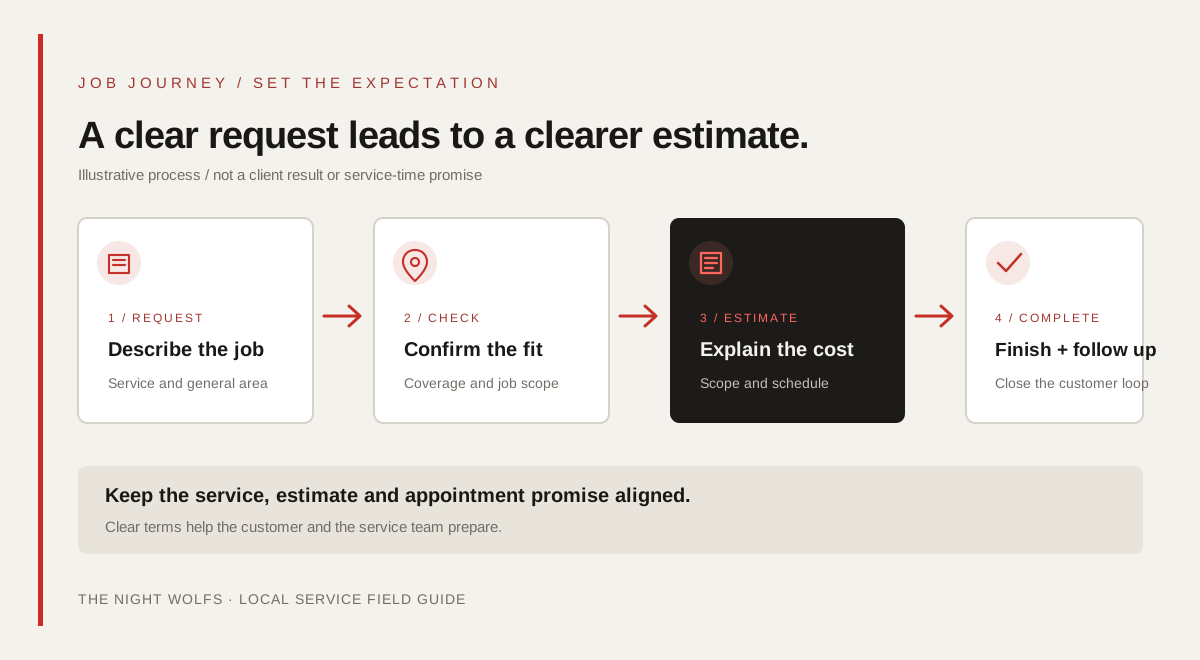
A useful service page explains what the provider does, what kinds of jobs fit, where the service is offered, how a visit is arranged and what information is needed for an estimate. For example, an air-conditioning page can distinguish routine servicing from a repair request without implying that every issue can be fixed in one visit.
Include practical details the team can keep accurate: arrival windows, inspection charges, what a quote includes, payment methods, exclusions and how changes are handled. Where price depends on the job, say what affects it and how the customer receives a final estimate.
Give each page a distinct purpose. Do not produce nearly identical neighbourhood pages that swap a suburb name but add no real local information. Google Search Central recommends useful, unique content; a location mention should help a customer decide whether the company can serve them.
LOCAL SEARCH / REPRESENT THE BUSINESS HONESTLY
Keep the local profile and service areas accurate
If the business is eligible for a Google Business Profile, use the real-world name, the right core category, a working phone number and accurate operating hours. Google asks service-area businesses to describe their actual service areas and follow the address display rules that apply to how they serve customers. A residential address should not be presented as a customer-facing storefront if customers are not served there.
Google’s service-area guidance uses named areas such as cities or postal codes rather than a radius circle. Choose coverage the team can realistically reach and maintain. Do not create extra profiles for every neighbourhood or add locations where the business has no eligible presence.
Keep the profile connected to a page that matches the listing. Update holiday hours, service availability and contact details when they change. Local visibility depends on factors beyond the owner’s control; Google describes local results in terms that include relevance, distance and prominence, so no profile edit guarantees a particular placement.
- Use the actual business name and a relevant primary category.
- Set the service area to places the team can genuinely cover.
- Follow current rules for displaying a customer-facing address.
- Check the phone, hours, website and service details regularly.
ESTIMATES / MAKE COSTS AND CONDITIONS VISIBLE
Explain quotes before a customer books
A quote page or enquiry confirmation should make clear whether an inspection or call-out has a fee, whether the estimate is binding, what labour or materials are included, and what might change the final price. If a no-cost inspection is conditional or limited, state the conditions close to the offer instead of hiding them in a later message.
Avoid false urgency, “lowest price” claims without evidence or a guaranteed repair outcome before the job has been assessed. The Advertising Standards Council of India’s code calls for truthful claims and cautions against misleading offers. For regulated work, describe only the qualifications and services the team is authorised to provide.
Use plain language for rescheduling, cancellations, deposits, warranties and payment terms. A customer should know what happens if a technician cannot reach the site or discovers that the requested work differs from the original description.
| Quote detail | What to explain |
|---|---|
| Inspection or visit | Whether it is free, paid or required before an estimate. |
| Estimate scope | What labour, materials and tasks are included. |
| Possible changes | What could affect price, timing or the work required. |
| Availability | The appointment window and how delays are communicated. |
| Payment and warranty | Accepted payment methods and any applicable terms. |
PROOF / EARN TRUST WITH REAL DETAILS
Show the work without exposing customer privacy
Photos of completed jobs can help customers understand the type of work a provider performs. Use images the company owns or has permission to publish, and describe the task accurately. Remove house numbers, faces, vehicle registrations, security details and other identifying information unless the customer has explicitly agreed to its use.
Credentials, insurance, manufacturer affiliations and warranties can help a customer evaluate a provider, but only list details that are current and verifiable. Do not imply that every technician holds a credential because one person does, or that an affiliation means a particular repair is guaranteed.
Ask customers for honest reviews after a completed job. Do not buy reviews, offer a reward for a positive rating or pressure someone to change criticism. If replying publicly, keep the response professional and do not reveal what work was performed at a customer’s address.
- Use permissioned photos of genuine work and remove private identifiers.
- Verify credentials, insurance and warranty wording before publishing.
- Request honest reviews without incentives or rating scripts.
- Reply to feedback without disclosing customer or job details.
CHANNEL MIX / MATCH THE URGENCY AND INTENT
Give each channel a practical job
A customer searching for an active repair need may respond to a service page, local profile or search campaign. Social content can explain maintenance, show a technician’s process or introduce the team. Referrals and housing-society relationships can add a trusted introduction. No channel is automatically best for every service or area.
Connect each channel to a page that repeats the same service, location, availability and quote terms. Start with the channels the business can answer reliably, then compare qualified enquiries and completed work rather than raw reach.
| Channel | Useful role | Check before scaling |
|---|---|---|
| Google Search and SEO | Reach people looking for a specific service or repair. | Service fit, coverage and quote information on the landing page. |
| Google Business Profile | Help local customers find an eligible business. | Real service area, working phone and current hours. |
| Paid search | Test a defined job type and coverage area. | Availability, lead quality and cost per completed job. |
| Social content | Show real work and answer common service questions. | Photo permission, accuracy and useful next steps. |
| Referrals and partnerships | Build introductions through trusted local relationships. | Clear terms and a reliable appointment owner. |
| WhatsApp or phone | Help customers ask questions or share job details. | Consent, response hours and a human escalation path. |
ENQUIRY HANDLING / MAKE RESPONSE RELIABLE
Set a response process the team can maintain
Decide who checks calls, forms and messages, during which hours, and what happens when that person is unavailable. Use a response expectation that reflects actual staffing. If the business cannot send a technician immediately, do not advertise “instant service” or an arrival time that has not been confirmed.
For a first enquiry, collect the service requested, general area, preferred time and a safe contact method. Explain if the team needs a call or site visit to understand the job. Avoid asking for more personal details than needed to schedule and assess the request.
A clear acknowledgement can confirm that the request arrived without suggesting that a job is accepted or scheduled. Send the confirmed appointment window only after the team has checked availability, and make changes easy to communicate.
WEBSITE / MAKE A REQUEST EASY TO COMPLETE
Keep the quote request short and mobile-friendly
A helpful form asks for the job type, approximate location, a brief description, preferred contact method and time window. Allow the customer to add a photo only when it genuinely helps assess the request, and explain how it will be used. Do not ask for access codes, payment card details or unnecessary identity information in a general marketing form.
Label every field, explain errors, preserve entered details after a validation issue and show a clear confirmation. Make phone and WhatsApp links work on mobile. Test the full path from request to the team’s inbox so a successful form submission does not disappear without an owner.
Keep job notes and customer contact details out of public URLs and general analytics events. Use the appropriate business system for sensitive job information, with access limited to people who need it.
FOLLOW-UP / CLOSE THE LOOP
Follow up on estimates, completed jobs and reviews
Record each request through a few useful stages: received, assessed, visit booked, estimate sent, approved, completed or not proceeding. If an estimate is waiting for a decision, use a relevant follow-up rather than sending repeated generic messages. Respect a customer’s request not to be contacted.
After completing a job, share any service notes or warranty information the customer needs. Invite an honest review without asking only satisfied customers or offering an incentive for a positive rating. If an issue arises, give the customer a working path to the person who can address it.
Separate operational messages from ongoing marketing. A request for a quote does not automatically mean the customer has agreed to receive unrelated promotions. Keep any marketing opt-in clear and easy to withdraw.
MEASUREMENT / CONNECT LEADS TO COMPLETED WORK
Measure the jobs the business actually completes
Track qualified enquiries, calls answered, site visits, estimates sent, estimates approved, jobs completed and cancellations. Agree on what counts as a qualified lead, for example that the service is offered, the location is covered and the requested timing is workable.
Use campaign tags and privacy-aware analytics to understand which pages or campaigns are generating requests. Avoid sending a customer’s name, phone number, full address, photos or job notes into analytics events or tracking URLs. Compare channel cost and staff time with the work completed, not only the cost of a form fill.
Review lost leads for patterns. If requests repeatedly fall outside coverage, revise the service area or landing page. If estimates are declined because the price was unexpected, make quote conditions clearer. If calls are missed after hours, adjust the campaign schedule or publish the actual response hours.
| Signal | Question to investigate |
|---|---|
| Qualified enquiries | Do the job type and location match the company’s real service? |
| Answered calls or messages | Is someone available when campaigns create demand? |
| Visits and estimates | Can the team assess and quote the work reliably? |
| Approved and completed jobs | Which channels lead to work the company can deliver? |
| Cancellations and complaints | Were availability, scope and terms clear from the start? |
ACTION PLAN / A FOUR-WEEK START
Use a four-week plan to improve local enquiries
Choose one service and one genuine coverage area. A narrow test makes it easier to find mismatches between the ad, landing page, response process and work the team can actually complete.
- Week 1: confirm services, qualifications, coverage, hours and quote conditions.
- Week 2: update the local profile and improve one service page.
- Week 3: test the phone, form, message route and estimate follow-up.
- Week 4: compare qualified enquiries, approved estimates and completed jobs.
- Assign an owner for listing updates, lead response and review requests.
This plan is a practical starting point, not a promise of rankings, lead volume or revenue.
THE DETAILS
Questions worth
asking early.
Clear answers about home services marketing in mumbai before you choose your next step.
How can a home-service business in Mumbai get more local enquiries?
Make service coverage, job types, quote conditions and response hours clear. Keep eligible local profiles accurate, build useful service pages and test that calls and forms reach a real person. Measure qualified enquiries and completed jobs instead of relying on traffic alone.
Should a service-area business show its home address?
Follow Google’s current service-area business guidelines. If customers are not served at the business address, the profile may need to hide that address and show the actual areas served instead. Check the current rules for your business model before editing the profile.
Should a home-service company create a page for every Mumbai suburb?
Only when the page provides useful, distinct information for a real service area. Repeating the same copy with a different neighbourhood name does not help customers decide whether the team can serve their job.
What should a home-service quote form ask?
Collect only what the team needs to understand and schedule the request, such as service type, general area, short job description and preferred contact method. Tell customers how optional photos will be used and keep private job details out of analytics.
Can home-service SEO guarantee top Google rankings?
No. Search visibility and lead volume depend on many factors. Accurate business information, useful service pages and reliable follow-up can improve the customer experience, but no agency or marketing change can guarantee a particular ranking or number of jobs.
SOURCES & FURTHER READING
- Google Business Profile Help — Guidelines for representing your business (opens in a new tab)
- Google Business Profile Help — Manage your service areas (opens in a new tab)
- Google Business Profile Help — Tips to improve your local ranking on Google (opens in a new tab)
- Google Search Central — SEO Starter Guide (opens in a new tab)
- Advertising Standards Council of India — The ASCI Code (opens in a new tab)