THE SHORT ANSWER
What matters most.
Start with the clinic’s real services, locations and capacity. Make the website explain who provides each service, what a first appointment involves and how to contact the clinic. Keep eligible business profiles accurate, publish useful information reviewed by appropriately qualified professionals and make booking accessible on mobile. Use respectful follow-up, collect only details the clinic needs, and avoid sending sensitive health information to advertising or analytics tools. Review enquiries and appointment outcomes with the clinic team; no tactic can guarantee rankings, patient numbers or clinical outcomes.
QUICK REFERENCE
Key takeaways.
- KEY POINT 01Represent only the clinic locations, practitioners and services that are real and currently available.
- KEY POINT 02Have qualified clinical reviewers check health-related content before publication and after material changes.
- KEY POINT 03Create clear service pages with provider details, appointment expectations and an accessible contact route.
- KEY POINT 04Keep local listings accurate and follow current platform rules for practitioner profiles and healthcare ads.
- KEY POINT 05Collect the minimum information needed for an enquiry and keep sensitive details out of ad tracking.
- KEY POINT 06Measure useful enquiries and attended appointments without promising rankings or treatment outcomes.
FOUNDATION / DEFINE THE SERVICE
Start with the clinic’s real services and capacity
Before choosing keywords or campaigns, list the services the clinic actually offers, the practitioners responsible for them, the locations where they are available and the appointment capacity the team can support. A clinic should not advertise a specialty, practitioner, diagnostic service or opening time that is not currently in place.
Be specific about the audience and need each service page is meant to help. A page for a first consultation may need to explain the appointment format, while a page for a diagnostic service may need preparation instructions confirmed by the clinical team. Avoid publishing general health advice as if it were a personal assessment.
Keep the public description consistent across the website, business profiles, directories and campaign landing pages. When a practitioner leaves, a location changes or an offering pauses, assign someone to update every public place where that information appears.
- Confirm practitioner names, qualifications, services and availability with the clinic.
- Separate services by location when they are not offered at every branch.
- Agree who can approve health-related copy and how often it is reviewed.
- Remove claims, offers and schedules that the clinic cannot substantiate or deliver.
CONTENT / MAKE EXPERTISE VISIBLE
Publish health information with clear professional review
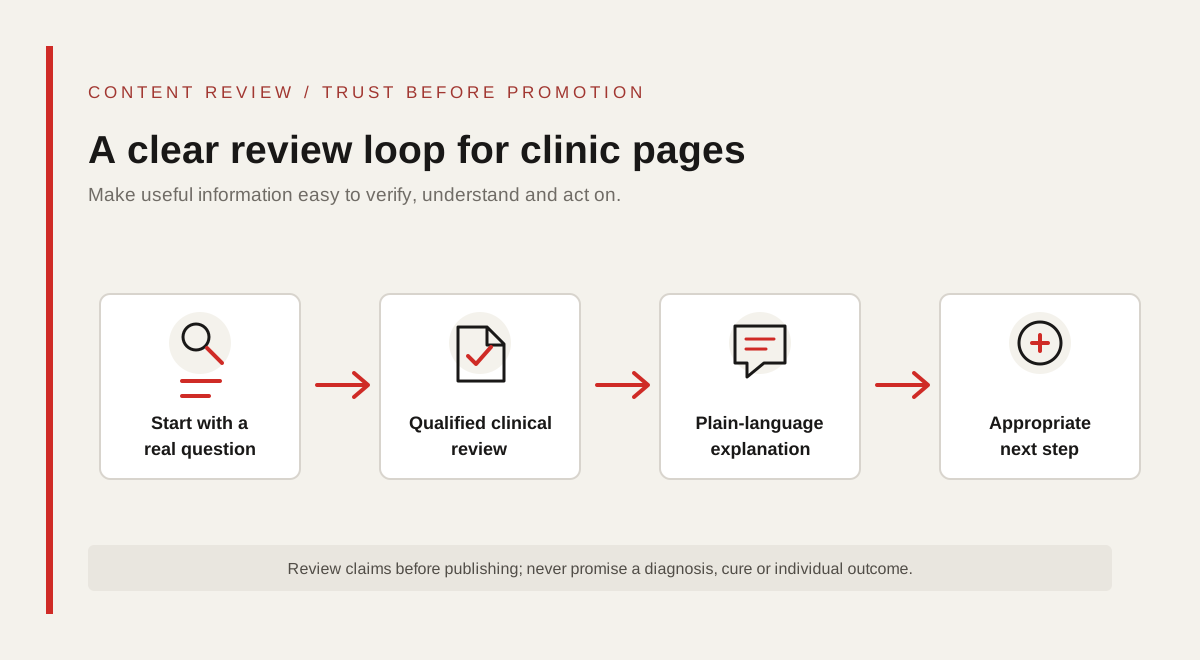
Health content can influence important decisions. Explain who wrote or reviewed a page, their relevant credentials and when the information was last checked. A biography should accurately describe the person’s training and role; it should not imply a qualification, registration or specialization the practitioner does not hold.
Write for a visitor who needs understandable, balanced information. Define clinical terms, explain when a page is general education rather than personal advice, and tell readers how to speak with a qualified professional. Do not promise a cure, guaranteed result or a fixed recovery timeline. If the evidence or individual circumstances affect the answer, say so.
Google Search Central recommends helpful, reliable, people-first content and says trust is especially important for topics that can affect health and wellbeing. Use that as a quality principle: answer the real question, show appropriate expertise and keep content maintained. It is not a formula for earning a particular position in Search.
- Name the author or clinical reviewer and describe their role accurately.
- Use evidence and references appropriate to the medical topic.
- Date meaningful reviews and correct outdated guidance promptly.
- Avoid diagnosing readers or implying that a marketing page replaces care.
WEBSITE / HELP A VISITOR DECIDE
Make each clinic service page useful before booking
A service page should explain what the clinic offers, who provides it, which location offers it and how a visitor can request an appointment. Include practical details the clinic has verified, such as appointment format, opening hours, accessibility information, contact methods and any clinic-approved preparation instructions.
Use plain language and a clear page structure. A visitor should be able to find the provider, service, address and next action without scanning a wall of text. Where a page describes possible options or risks, have a qualified clinician confirm that the language is balanced and appropriate.
Create a separate page only when it adds genuinely useful information—for example, a distinct service, provider or branch with meaningful differences. Do not make dozens of near-identical neighbourhood pages by swapping locality names. A location page should describe a real clinic and help people understand how to reach it.
| Page element | Useful information to provide |
|---|---|
| Service | What the clinic actually offers and which practitioner provides it. |
| Location | The real branch address, access details and current operating hours. |
| Appointment | How to request a visit, what happens next and how to reschedule. |
| Trust | Accurate provider credentials, reviewer information and content date. |
| Accessibility | Readable text, keyboard-friendly controls and clear contact alternatives. |
LOCAL DISCOVERY / REPRESENT THE REAL CLINIC
Keep local profiles accurate and policy-compliant
For eligible locations, keep the clinic’s public name, address, phone, hours, website and category accurate on its Google Business Profile and other directories. Use the name the clinic uses in the real world; do not add specialties, neighbourhoods or keywords to the name just to influence search results.
Google’s local-ranking guidance describes relevance, distance and prominence as important factors. The clinic can improve the accuracy and usefulness of its information, but it cannot control the searcher’s location or guarantee where a result will appear. Do not create a profile for a virtual office or a location where the clinic does not actually operate.
Practitioner and multi-location listings can have additional platform requirements. Check Google’s current representation rules before creating separate practitioner profiles or making ownership changes. Keep the clinic’s authorized team in control of the profile and give vendors only the access they need.
- Use a real, eligible clinic location and the clinic’s actual public name.
- Check map pins, phone numbers, website links and holiday hours on mobile.
- Update profiles when practitioners, services or branches change.
- Follow current platform rules for practitioners and duplicate locations.
APPOINTMENT PATH / CONNECT DISCOVERY TO CARE
Design a respectful journey from discovery to appointment
Make the next step predictable. A booking form should say which branch or service it concerns, what happens after submission, when the clinic typically responds and how someone can contact the team if the request is urgent. Do not label a general enquiry form as emergency care or imply that a message is monitored continuously unless the clinic truly provides that service.
Ask only for information needed to route the request. Avoid placing symptoms, diagnoses, reports, prescriptions or other sensitive health details into advertising pixels, analytics events, URL parameters or public chat transcripts. Where clinical information is needed, direct the person to a clinic-approved secure channel and explain how the clinic handles it.
A person should be able to choose a phone or other suitable contact route if an online form does not work for them. Confirm the request clearly, give a realistic response expectation and provide an accessible way to correct or withdraw contact details.
The journey below is a planning illustration, not patient data or a clinic performance result.
CHANNEL MIX / MATCH INTENT AND SAFEGUARDS
Choose channels the clinic can support responsibly
Organic search can help people find relevant service and location information. Local profiles can answer practical questions about a real branch. Paid search may reach people actively looking for a service, while social content can introduce the clinic’s team, facilities or general education. Each route has different platform rules, costs and operational requirements.
Before launching paid campaigns, check the current platform policy for healthcare and the target location. Google Ads restricts some healthcare-related products, services and targeting; eligibility can vary by category and geography. Do not assume an ad is permitted because a competitor is running one. Ask the clinic’s responsible reviewer to approve claims and landing pages.
Start with one measurable service and a clear destination page. Confirm that the clinic has appointment availability, staff to respond and a way to distinguish useful requests from irrelevant traffic. Expand only after the team understands the quality, cost and service impact of the first test.
| Channel | Possible role | Clinic check before scaling |
|---|---|---|
| Organic search | Answer service, provider and location questions. | Is the page accurate, useful and clinically reviewed? |
| Local profiles | Share real branch details and a route to the official site. | Is the location eligible and information current? |
| Paid search | Test demand for an eligible service or appointment route. | Do current healthcare policies allow the ad and targeting? |
| Social content | Introduce the team, facilities or general education. | Are permissions, claims and professional review in place? |
REPUTATION / PROTECT PEOPLE AND TRUST
Handle reviews and testimonials with care
Reviews may help a person understand another customer’s experience, but they are not clinical evidence and should not be presented as a typical treatment outcome. Ask for honest feedback in a neutral way and follow platform rules. Do not buy reviews, offer a reward for a positive rating or selectively ask only satisfied visitors to post publicly.
When replying, avoid confirming that a reviewer is a patient or discussing their care in public. Keep the response brief, respectful and general; invite the person to contact the clinic through an appropriate private channel. Do not share appointment details, health information or screenshots as proof.
If the clinic uses a testimonial or case study, confirm permission, accuracy and any applicable professional or advertising requirements before publication. Clearly distinguish an individual story from a promise about what another person will experience.
- Use neutral review requests and follow each platform’s current policy.
- Never disclose or confirm someone’s patient status in a public reply.
- Get permission for testimonials and keep context around individual outcomes.
- Have the clinic approve claims and patient-facing creative before publication.
ACCESSIBILITY / REMOVE AVOIDABLE FRICTION
Make service information and appointment tools accessible
People may use a phone, keyboard, screen reader, zoom or voice input to research and contact a clinic. Use readable contrast and type, visible focus states, properly labelled form fields, descriptive link text and meaningful alternative text for important images. Keep schedules and instructions as text rather than placing essential information only inside a graphic.
Test the complete appointment path on a small screen: open a service page, find the branch, select a contact method, submit a request and understand the confirmation. Check that error messages explain how to recover and that phone details remain available if a booking widget is inaccessible.
The W3C Web Accessibility Initiative describes WCAG as an international standard for making web content more accessible. Use it as a reference for evaluating the site; do not claim conformance without a proper assessment.
MEASUREMENT / TRACK SERVICE, NOT SENSITIVE DETAILS
Measure useful enquiries while protecting privacy
Track operational milestones such as service-page visits, successful appointment-request submissions, call clicks and attended appointments where the clinic’s systems and permissions support it. Use aggregated reporting to compare locations, services and channels, then ask staff whether the requests were relevant and manageable.
Do not place a person’s name, phone, email, symptoms, appointment reason or medical record identifiers into analytics events, URLs, ad-platform audiences or campaign labels. Keep tracking separate from clinical records, restrict access and review any tag or booking integration with the clinic’s privacy and technology owners.
Define what counts as a qualified enquiry with the clinic before reporting performance. A click, form submission, booked slot and attended appointment are different events. Report them separately and avoid attributing clinical outcomes to a marketing campaign.
| Signal | What it can show | Keep in mind |
|---|---|---|
| Service-page visit | A visitor reached information about a service. | A visit does not mean the person needs or will book care. |
| Appointment request | A request was submitted through the chosen path. | Do not send identifying or health details to analytics. |
| Confirmed appointment | The clinic accepted a request into its workflow. | Use a privacy-reviewed, preferably aggregated connection. |
| Attended appointment | The clinic recorded attendance. | Report only with appropriate access and privacy safeguards. |
OPERATIONS / REVIEW THE WHOLE PATH
Run a simple monthly clinic marketing review
Bring marketing and clinic operations together for a short review. Confirm that provider and service information is current, profiles point to the right pages, booking tools work on mobile, enquiries are assigned to an owner and no expired campaign remains live. Ask staff where prospective patients still get confused.
Compare service-page engagement and appointment requests with available appointment capacity. If one service is fully booked, adjust the campaign or make the availability clear rather than continuing to generate requests the clinic cannot handle. If a campaign brings irrelevant enquiries, review the query, audience, message and destination together.
Choose one improvement, record when it changes and review the result after a suitable period. Search visibility and appointment volume depend on many factors; a checklist supports better practice but cannot promise a ranking, patient count or clinical result.
- Verify practitioner, location, service and contact information.
- Test key landing pages and booking paths on desktop and mobile.
- Review enquiry quality, appointment availability and unanswered requests.
- Check consent, privacy, platform policies and clinical approvals for live campaigns.
- Document one change and its operational result before expanding the work.
THE DETAILS
Questions worth
asking early.
Clear answers about healthcare marketing in mumbai before you choose your next step.
How can a clinic improve local visibility in Mumbai?
Represent the real clinic accurately, maintain eligible profiles, publish useful pages for actual services and locations, and make contact information consistent. Google says local results depend on factors including relevance, distance and prominence; no clinic can guarantee a specific position.
Can clinics advertise healthcare services on Google Ads?
Some healthcare advertising is restricted, and requirements may vary by service and location. Review Google Ads’ current healthcare and medicines policy before creating campaigns and have the clinic approve the ad and landing-page claims.
What should a clinic include on a service page?
Explain the service the clinic actually provides, who provides it, where it is available, how to request an appointment and what happens next. Have qualified clinical staff review health-related statements and keep practical details current.
Should health details be tracked in marketing analytics?
Avoid sending identifiable or sensitive health details to advertising or analytics tools. Track only the minimum operational events needed, use privacy-reviewed systems and ask the clinic’s responsible privacy or technology owner to assess integrations.
Can healthcare marketing guarantee more patients or higher rankings?
No. Marketing can improve information quality, accessibility and measurement, but search positions and appointment demand depend on many factors. Avoid promises about rankings, patient volume or medical outcomes.
SOURCES & FURTHER READING
- Google Search Central: Creating helpful, reliable, people-first content (opens in a new tab)
- Google Business Profile Help: Tips to improve your local ranking on Google (opens in a new tab)
- Google Business Profile Help: Guidelines for representing your business on Google (opens in a new tab)
- Google Ads Policy: Healthcare and medicines (opens in a new tab)
- W3C Web Accessibility Initiative: WCAG 2 Overview (opens in a new tab)