THE SHORT ANSWER
What matters most.
Start by confirming the product, fulfilment and customer support are ready. Give each channel a clear job, keep product feed and landing-page details accurate, use truthful offers and measure the whole ecommerce path from product view to completed purchase. Review order value alongside delivery, payment, promotion and return costs, then decide whether the campaign supports sustainable growth for the business. No channel or optimization guarantees a specific ranking, order volume or profit.
QUICK REFERENCE
Key takeaways.
- KEY POINT 01Confirm stock, delivery areas, returns, payment and support before promoting a launch.
- KEY POINT 02Use a product page that answers the questions customers need to decide.
- KEY POINT 03Keep product feed information consistent with the live landing page.
- KEY POINT 04Give search, social, creators, email and retargeting distinct roles in the journey.
- KEY POINT 05Track product views, cart actions, checkout and completed purchases accurately.
- KEY POINT 06Compare acquisition cost with order contribution and customer experience—not revenue alone.
LAUNCH READINESS / PROMISE WHAT YOU CAN DELIVER
Confirm the product and fulfilment are ready
Before planning launch spend, confirm what is available to sell, how orders are packed, which locations can be served, how delivery timing is stated and who handles customer questions. A product can attract attention while the business is still not prepared to accept or fulfil orders; that gap can create confusion, cancellations and avoidable support work.
Set clear stock and offer conditions. If the launch is limited to selected colours, sizes, locations or dates, state that near the offer. Do not advertise a delivery estimate the operations team cannot support or a discount that does not apply to the products shown.
Map the exception paths as carefully as the successful one: what happens when payment fails, stock changes, a parcel is delayed or the customer requests a return? Assign an owner to each step so marketing and operations are working from the same information.
- Verify the product, variants, current price and available stock.
- Confirm shipping coverage, expected delivery information and return terms.
- Test payment, confirmation emails and customer-support routes.
- Identify the person who updates product availability and launch offers.
POSITIONING / START WITH A REAL CUSTOMER NEED
Choose one clear customer and product problem
“Everyone who shops online” is too broad to guide a product launch. Describe who is most likely to value the product, what situation it helps with, what alternatives they compare and what evidence would help them choose. Use customer conversations, sales questions, reviews and product returns to form and refine that picture.
A useful position explains the product’s distinctive features without turning them into unsupported claims. If the product is designed for a particular use, show how it works and who it suits. If a claim depends on a test, certification or health outcome, verify the evidence and applicable rules before publishing.
Pick one priority product or collection for the first campaign. A focused page and message make it easier to learn which audience, question or creative attracts suitable buyers than mixing several unrelated products into one broad ad.
PRODUCT PAGE / ANSWER BUYER QUESTIONS
Make each priority product page easy to evaluate
A shopper should be able to identify the exact product, understand its use and compare relevant options without guessing. Show clear images, a specific product name, variant details, price, availability and useful specifications. Include care, size, material, compatibility or ingredients where those details matter to the category.
Explain delivery, payment, cancellation, exchanges and returns in plain language. Put important conditions close to the purchase action rather than hiding them across the site. Make sure the mobile page loads, product choices work, and the add-to-cart and checkout steps show the right product and price.
Use the customer’s questions to improve the page: what is included, which variant fits, how long delivery may take, what happens if the item does not suit them, and how to reach support? Answering those questions is more useful than adding generic keywords that do not help someone decide.
| Page element | What a shopper needs to know |
|---|---|
| Product identity | What is this item, and which variant am I viewing? |
| Images and details | Can I see the item and understand the features that matter? |
| Price and availability | What does it cost, and can it be ordered now? |
| Delivery and returns | Where can it be sent, when might it arrive and what if it does not fit? |
| Next step and support | How can I buy, ask a question or get help with an order? |
PRODUCT DATA / AVOID FEED AND PAGE MISMATCHES
Keep the product feed and landing page aligned
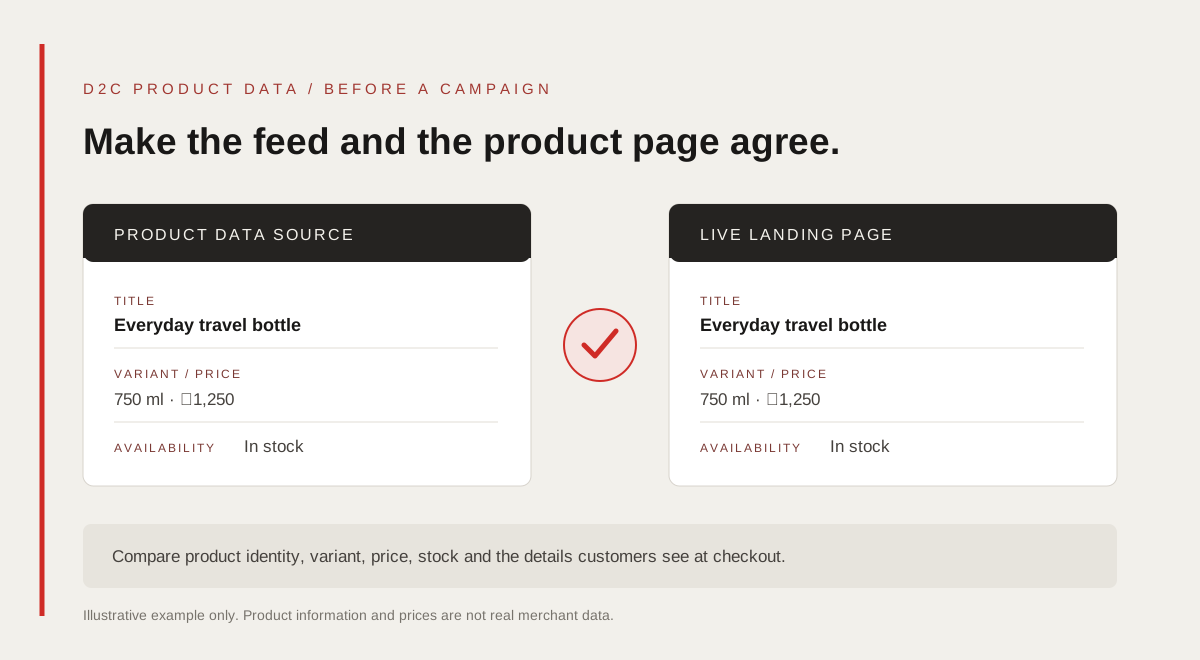
If the brand uses Google Merchant Center, the product data specification is a practical checklist for details such as title, description, image, price, availability and product identifiers. Google says accurate and correctly formatted product data helps match products with queries and can prevent disapprovals or display issues.
Compare the feed with the live product page whenever price, stock, shipping or a variant changes. A listing that advertises one option but lands on another can frustrate shoppers and may create platform eligibility problems. Check the target country, language and current product requirements before adding or changing feed fields.
Use consistent product identifiers and variant relationships where the brand has them, and do not invent identifiers. If the site updates stock automatically, test how that information reaches the product data source and how quickly the customer-facing page reflects the change.
CHANNEL STRATEGY / MATCH THE CUSTOMER MOMENT
Give every launch channel a distinct role
A channel plan should explain how the customer might discover, compare, buy and return—not simply list every platform the business can post on. Search can help reach shoppers already looking for a product or solution. Social creative can introduce a product and demonstrate how it is used. Email can tell subscribers about a launch they chose to hear about. Paid retargeting can remind eligible visitors about products, subject to the platform’s current settings and the site’s consent choices.
Choose a small mix the team can operate well. Make sure each campaign sends people to the matching product or collection page and that the message, price, variant and offer are consistent. A campaign should not send traffic to a sold-out item or make an offer the checkout cannot honour.
| Channel | Potential role | Readiness check |
|---|---|---|
| Organic search | Answer product and category questions over time. | Useful category and product pages with accurate details. |
| Paid search or shopping | Reach demand for a product or category. | Current product data, availability and a matching landing page. |
| Social content and ads | Show the product in context and introduce a new collection. | Permissioned images, clear claims and a relevant purchase path. |
| Creators or partners | Add a distinct demonstration or audience perspective. | Clear briefing, verified claims and appropriate disclosure. |
| Email or messaging | Share launch and product updates with people who opted in. | Accurate audience permissions and a reliable support owner. |
CUSTOMER JOURNEY / CONNECT EACH HANDOFF
Connect acquisition to a fulfilled order
The ad or post, product page, cart, checkout, confirmation and delivery message are one customer journey. Keep product names, prices and promises consistent as a shopper moves between them. Make it clear when the order is confirmed, what the customer should expect next and where to get help.
For launches, prepare customer-service responses for common questions about product choice, sizes, ingredients, delivery, payment and returns. Use those questions to improve the product page and ad creative. If an item goes out of stock or an offer changes, pause or update the relevant messages rather than letting the customer discover the mismatch at checkout.
When creators, reviewers or customers share product experiences, use content with permission, describe the relationship honestly and avoid presenting an individual opinion as proof that every buyer will get the same result. ASCI’s advertising code is a useful starting point for truthful and responsible advertising in India; review current platform and category rules as well.
- Test the complete order path on a phone and desktop.
- Confirm the order email or message matches the selected variant and price.
- Prepare a clear escalation route for delayed, cancelled or returned orders.
- Use approved creative and accurate product claims across the campaign.
RETENTION / MAKE FOLLOW-UP USEFUL
Plan for the customer after the first purchase
Retention is not a sequence of automatic discount messages. First make sure the customer receives clear order updates and product-use information. Then identify useful follow-up based on the product and the customer’s stated communication preferences: care guidance, a complementary item, a replenishment reminder when appropriate or a way to get support.
Separate operational messages about an existing order from promotional messages about future products. Tell people what marketing updates they are choosing to receive, use a clear opt-in where required, and respect unsubscribes or channel preferences.
Review repeat purchase by product and cohort only when the underlying order data is reliable. A product used up quickly may have a different reorder pattern from a long-lasting product. Do not assume a single repeat-purchase timeline or message frequency fits every category.
ANALYTICS / MEASURE THE REAL CHECKOUT PATH
Track product discovery through purchase
Google Analytics documents ecommerce events for actions such as viewing an item, adding it to a cart, beginning checkout and completing a purchase. Implement the events that fit the store, and send the relevant item, value and currency details accurately. Test the events against real user actions; a page view or checkout button click is not the same as a completed order.
Check that purchase events are not duplicated on confirmation-page refreshes and that cancelled or failed payments are not counted as completed purchases. Use the store’s order system as the source of truth for sales, and compare it with analytics while accounting for consent, blockers, attribution settings and processing differences.
Keep names, email addresses, phone numbers and full delivery addresses out of analytics events and campaign URLs. Use consent settings appropriate to the website and region. Report product views, add-to-cart actions, checkout starts, completed orders, returns and support issues as different steps rather than calling all of them conversions.
| Journey stage | A useful question |
|---|---|
| Product view | Did the visitor reach the intended product and variant? |
| Add to cart | Was the price, offer and availability clear enough to proceed? |
| Begin checkout | Can the shopper see delivery and payment details before confirming? |
| Purchase | Does the order record match product, currency and value sent to analytics? |
| Return or support | Did fulfilment and product expectations match the promise? |
BUSINESS RESULTS / LOOK BEYOND TOP-LINE SALES
Review order economics, returns and customer fit
Revenue does not show what remains after product cost, shipping, packaging, payment fees, discounts, returns and customer support. Build a simple order-level view that uses the costs relevant to the business, then compare that contribution with acquisition spend and any other campaign costs you include.
Keep calculations consistent. For example, a campaign acquisition-cost figure should use the spend and the new customers defined for that same campaign and period. If attribution is incomplete or repeat orders happen later, say so in the review rather than treating every recorded sale as caused by one ad.
Look at returns, cancellations, delivery failures, customer questions and repeat orders alongside campaign metrics. If a product attracts clicks but produces frequent returns because its size or fit is unclear, improving the product information may be more useful than increasing traffic.
- Use completed orders, not just clicks or checkout starts.
- Separate new-customer acquisition from repeat orders where the data allows.
- Include relevant discounts, delivery, payment and return costs consistently.
- Review cancellations, complaints and support load before scaling spend.
ACTION PLAN / START SMALL AND LEARN
Use a four-week D2C launch review
A short review plan makes ownership clear. It does not guarantee a specific result or mean every brand should scale after four weeks; use the period to find problems in the product page, campaign message, order flow or measurement before making the next decision.
| Week | Focus | Check |
|---|---|---|
| 1 | Product and fulfilment readiness | Stock, price, variants, delivery, returns, payment and support owner. |
| 2 | Page and data quality | Mobile product page, checkout, feed consistency, analytics events and consent. |
| 3 | Focused campaign test | One priority product, a defined audience, capped spend and a working response path. |
| 4 | Order and customer review | Completed orders, contribution, returns, questions and the next improvement. |
Keep a short decision log: what changed, why, what the business observed and what it will check next. Increase investment only when the product, operations and evidence support that decision.
THE DETAILS
Questions worth
asking early.
Clear answers about d2c marketing in mumbai before you choose your next step.
What does D2C marketing mean?
D2C, or direct-to-consumer, describes a brand selling directly to customers through its own website, app, store or other direct channel. The marketing plan connects product discovery with the brand’s own purchase and customer-support experience.
Which channel should a new D2C brand use first?
Choose based on how customers discover and compare the specific product, the team’s ability to fulfil orders and the budget available for a controlled test. Search, social, creators, email and other channels have different roles; none guarantees sales.
What should a D2C product page include?
Use clear product and variant details, images, accurate price and availability, useful specifications, delivery and return information, a working checkout and an easy support path.
What ecommerce events should an online store measure?
Google Analytics documents events for shopping actions including viewing an item, adding to cart, beginning checkout and purchase. Implement only events that correspond to real actions and validate item, value and currency data.
How should a D2C brand evaluate marketing performance?
Connect campaign spend with completed orders and review relevant product costs, delivery, payment, discounts, returns and customer support. Interpret attributed sales carefully and compare them with the store’s order records.
Can a D2C marketing campaign guarantee sales or profit?
No. Campaigns can test messages and reach potential customers, but results depend on product demand, price, competition, fulfilment, customer experience, measurement and other factors.